General information
Reporting framework
Approach to sustainability reporting
Initially, NS was to be required to report in accordance with the guidelines of the Corporate Sustainability Reporting Directive (CSRD) and its standards with effect from its 2025 annual report, as part of the 'second wave' of companies with a reporting obligation. Due to the European Union’s Omnibus proposals, NS's obligation to report in accordance with the CSRD has been postponed until the 2027 annual report, which will be published in 2028. NS has therefore chosen to continue reporting its sustainability information based on the GRI standards until that time. However, NS did change the structure of the 2025 annual report and has already partially aligned it with the system prescribed for CSRD reports.
Reporting criteria
This Sustainability Report has been prepared with reference to the GRI Standards 2021. The GRI content index (new window) can be found on the annual report website. We also report additional company-specific indicators, including performance indicators for the main rail network (HRN), which are set out in the Main Rail Network Concession for 2025-2033 (HRN concession 2025-2033). The year 2025 marked the first year of the Main Rail Network Concession for 2025-2033. The concession contains changes in indicators and scope compared to the Main Rail Network Concession for 2015-2024. This report therefore does not include any comparative figures for the main rail network performance indicators.
For CO2 calculations, we work according to the guidelines from the Greenhouse Gas (GHG) Protocol. To calculate the main rail network performance indicator 'CO2 emissions avoided', we adhere to the agreements with our contracting authority.
Scope
Our annual sustainability report covers the period 1 January 2025 to 31 December 2025 and includes NS's consolidated operations within the Social, Environment and Governance components. The scope of consolidation of the sustainability report is the same as that of the financial statements. The sustainability report also includes, where relevant, information on the supply chain (upstream value chain) and market chain (downstream value chain). Following assessments of our entire value chain, we identified material themes, determined their relative impact and reported on the relevant parts of the value chain for each theme.
Any changes in definitions or inherent limitations in the data compared with last year are stated in this report.
Estimates and assessments
In this sustainability report, we use estimates and assessments carried out according to the procedures in our reporting manual. The most important estimates and assessments concern:
emissions due to procurement, where product information or supplier-specific information is lacking (scope 3);
emissions due to transport before and after the train journey (scope 3);
unknown material inflows.
Governance
The governance of sustainability themes within NS is controlled by the Executive Board, which sets the ambitions and goals. The CSR Council, consisting of directors of various business units, acts as a policy-making body and meets under the leadership of the Executive Board member for CSR (Corporate Social Responsibility), the Director of People & IT. Progress on sustainability is monitored through the regular planning, control and reporting cycle, with the CSR Council discussing results on a quarterly basis. The various management teams and business unit directors are responsible for decisions within their areas of responsibility and are consulted when necessary.
Where necessary, policy proposals and decisions are submitted to the Executive Board for approval. The Council also reports twice a year to the Supervisory Board or Supervisory Board committees (Risk and Audit Committee). The Sustainable Enterprise department translates the Executive Board's sustainability goals into strategy and policy. The business units implement the policy.
External assurance
KPMG has provided limited assurance on this sustainability report at NS's request. See also the independent auditor's limited assurance report on sustainability information starting on page 267.
Strategy, business model and value chain
NS serves the public interest and, as a state-owned company, contributes to addressing societal challenges. We are responsible for rail transport on the Dutch main rail network, including the high-speed line. We are also making every effort to ensure that the station and surrounding area offer a pleasant and welcoming environment for passengers. NS posted revenues of €3,920 million in 2025. Of this, €556 million related to station development and operation. The number of own employees as at 31 December 2025 was 21,369.
Strategy
The guiding principles of our strategy are reliable, affordable and committed. We get passengers from A to B on time, safely and in a seat (reliable), offer a competitive and cost-conscious service in terms of price, travel time and convenience compared to cars, planes and other carriers (affordable), and help to bring people together and to ensure equal opportunities and a viable future for the world (committed). NS’s efforts to be reliable, affordable and engaged are dependent on a proud and healthy workforce. A solid governance structure is the foundation of our operations.
These principles and preconditions are linked to our material themes, which are explained later in this chapter in the 'Double materiality assessment' section. The principles of reliable and affordable are linked to the theme of 'Accessibility'. Committed is reflected in the themes 'Climate and energy', 'Circularity and material use', 'Accessibility' and 'Workers in supply chains'. The precondition 'proud and healthy NS employees' is directly linked to the theme 'Being an attractive and inclusive employer' and the condition of a solid governance structure with the theme 'Good governance'.
Business model
Our business model plays a central role in adding value to society. NS focuses on train transport in, to and from the Netherlands, the station and the door-to-door journey. We implement our strategy through these core activities. The main sources (inputs) for ensuring the optimal functioning of our business model are people, trains, stations, other physical locations such as maintenance facilities, rail infrastructure, raw materials, energy and technology.
The activities in our business model have various measurable results (outputs), for example the number of train journeys and public transport bicycle journeys per day, employee satisfaction, CO2 emissions, energy consumption and material outflow. These are results where we are aiming for certain outcomes for groups or society. Examples include making the Netherlands more accessible, providing a safe, diverse and inclusive working environment and avoiding CO2. These outcomes have an impact on the Netherlands. Bringing people together, enabling them to take part in society and ensuring a viable future for the world.
See the report of the Executive Board for more information on our strategy, organisational structure and .
Value chain
NS's value chain includes all activities that contribute to achieving our mission: ‘Together, we are making the Netherlands accessible in a sustainable manner – for everyone.’ The value chain picture shows at a glance the material sustainability issues at each step in our chain.
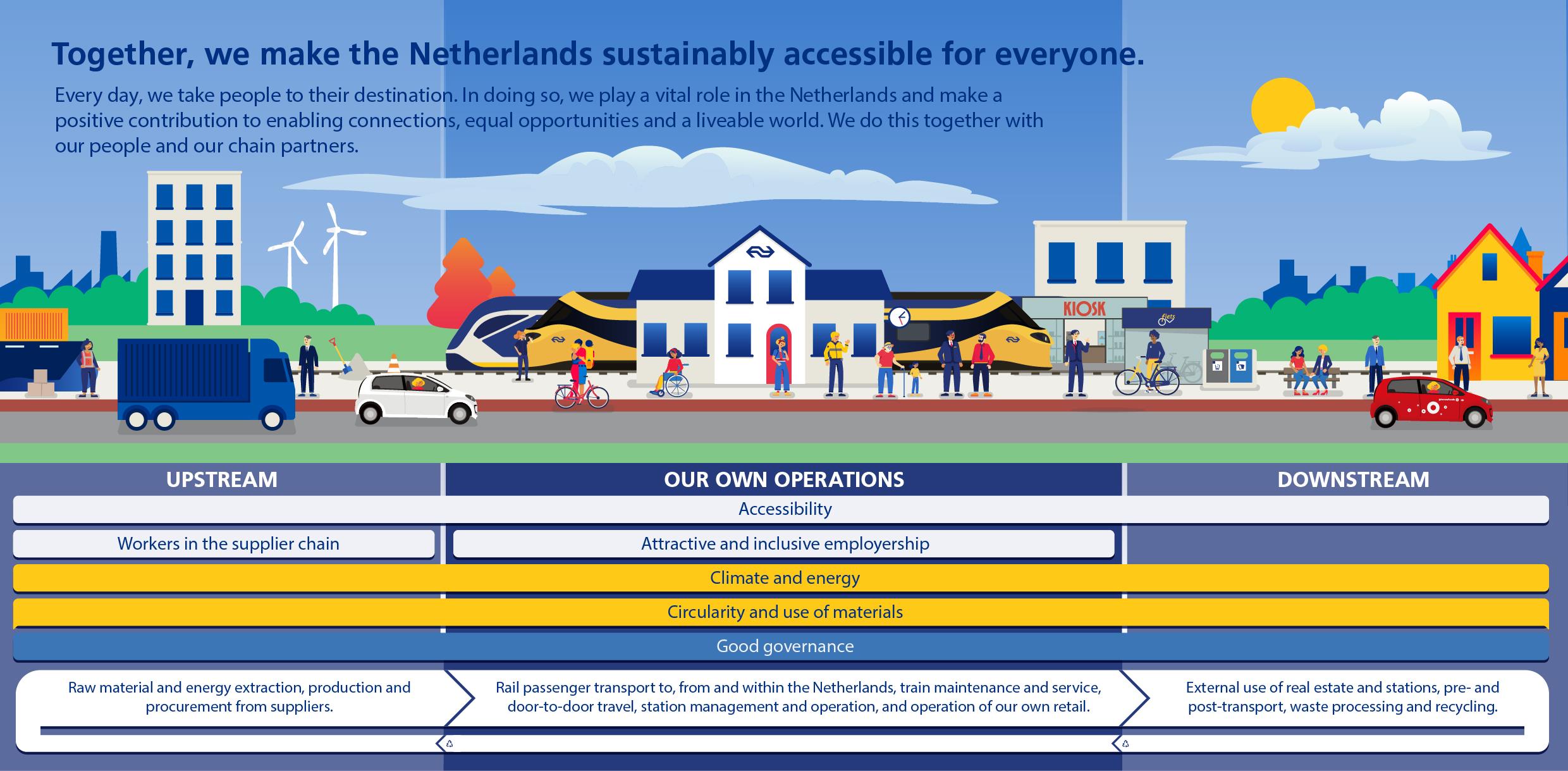
Our chain starts upstream with the production and procurement of rolling stock, materials and energy, followed by infrastructure management and maintenance. Our operations involve planning and operating train services, including passenger and customer service, and maintaining and servicing of rolling stock. We also focus on door-to-door travel by offering chain services such as public transport bicycles and P+R. NS Stations manages and maintains stations and the in-house retail formulas, as well as running stations and real estate. Downstream activities are the external use of real estate and stations and our passengers’ transport before and after their train journey. Our chain concludes with waste disposal and recycling.
Our main suppliers are suppliers of trains, components, human resources and facility services, IT, construction, the retail product range and energy. ProRail is a supplier of rail infrastructure. Our customers are our passengers (consumers and businesses), real estate tenants and station visitors.
Double materiality assessment
We completed the review of our double materiality assessment in 2025. The material topics provide insight into the impact of NS on societal issues (impact materiality) and, conversely, the way in which such issues influence the development, performance and position of NS (financial materiality). The materiality assessment exclusively concerns topics in connection with which NS has an impact on society (both positive and negative) or topics with a potential impact on NS (risks and opportunities).
We applied the GRI standards to determine the material themes, also taking into account the future requirements of the CSRD. A longlist of sustainability topics was drawn up based on a comprehensive internal inventory, the 2024 materiality assessment and a variety of internal and external sources. This list takes into account NS's own operations, geographical operating areas and activities in the value chain. The sustainability topics on the longlist were then clustered and defined, after which impacts, risks and opportunities (IROs) were identified for each topic.
Once the definitions and the impacts, risks and opportunities had been formulated, the impacts were assessed for scope, scale, recoverability and probability and the opportunities and risks for magnitude/effect and probability. NS uses a threshold for prioritising IROs. An issue is considered material if it is material on at least one of the two criteria (impact or financial). The threshold set is in line with NS's risk appetite and has been approved by the Executive Board.
We discussed the preliminary results of our materiality assessment with an extensive selection of our external partners and stakeholders. We did this through our existing stakeholder dialogue. After validation with external partners and stakeholders, we further refined the double materiality assessment. NS has identified six material themes. The final themes were determined by the Executive Board. The Supervisory Board was informed throughout the process.
Our double materiality assessment shows that available information on the upstream value chain is currently limited. Additional information and research are needed to identify potential impacts, risks and opportunities in the areas of biodiversity, pollution and water. This also applies to gaining a better understanding of NS's potential impacts on employees in the upstream value chain. NS will take any new insights into the upstream value chain into account in future re-evaluations of the double materiality assessment.
Material topics
The diagram below provides an overview of our material sustainability themes:
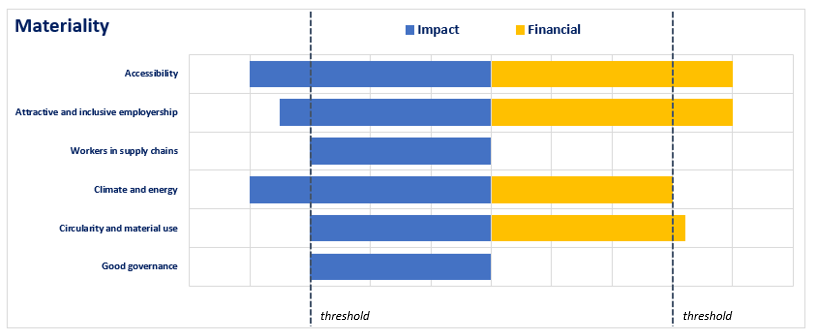
The number of themes has been reduced compared to 2024, primarily by merging several topics. The 2024 themes 'Operational performance', 'Customer satisfaction', 'Door-to-door journey' and 'World-class stations' have been brought together in 2025 under the overarching theme of 'Accessibility'. At the same time, the 2024 theme 'Sustainable enterprise' has been split into the topics 'Climate and energy', 'Circularity and material use' and 'Workers in supply chains' in 2025. See the table below for a detailed explanation of the sustainability themes, including relevant impacts, risks and opportunities.
|
Theme/sub-theme |
Material impacts, risks and opportunities |
Value chain |
|
|---|---|---|---|
|
1. Accessibility |
|||
|
Reliable and accessible transport |
NS's impact on making and keeping the Netherlands accessible |
Positive impact |
Downstream |
|
NS's impact on the ability of people with disabilities to participate in society |
Positive impact |
Downstream |
|
|
Risk of increasing timetable disruptions due to insufficient availability of rolling stock |
Risk |
Own operations |
|
|
The risk of increasing timetable disruptions due to insufficient quality or availability of infrastructure |
Risk |
Upstream |
|
|
Safety |
The impact of the safety of NS' operations on people's well-being |
Negative impact |
Downstream |
|
The risk of process failure due to a cyber-security incident |
Risk |
Own operations |
|
|
2. Attractive and inclusive employership |
|||
|
Employment conditions and employment relations |
NS's positive or negative impact on employees as a result of the offered employment conditions and employment relations |
Positive and negative impact |
Own operations |
|
Diversity and inclusion |
The positive impact of a diverse and inclusive working environment on employee engagement and well-being |
Positive impact |
Own operations |
|
Public safety and healthy working environment |
The risk of increasing aggression in society |
Risk |
Own operations |
|
Recruitment, training and development |
The risk of staff shortages in crucial locations |
Risk |
Own operations |
|
3. Workers in supply chains |
|||
|
Working conditions in supply chains |
NS's potential impact on working conditions and human rights of workers in its supply chains |
Positive and negative impact |
Upstream |
|
4. Climate and energy |
|||
|
Climate mitigation |
The positive impact of CO2 emissions avoided by offering sustainable transport options as an alternative to travel by plane and car |
Positive impact |
Own operations |
|
The negative impact of CO2 emissions caused in NS's value chain, related to NS's operations (scope 1, 2 and 3 emissions) |
Negative impact |
Entire value chain |
|
|
The negative impact of energy consumption in NS's operations on the availability of energy in the Netherlands |
Negative impact |
Own operations |
|
|
Climate adaptation |
The risk of critical stations and buildings becoming inaccessible or unavailable due to access restrictions or damage caused by increasing flooding and high temperatures as a result of climate change |
Risk |
Own operations |
|
The risk of timetable disruptions due to infrastructure failures and constraints caused by increasing flooding and drought as a result of climate change |
Risk |
Upstream |
|
|
5. Circularity and use of materials |
|||
|
Material inflows and material use |
The impact of the use of materials and raw materials in NS's operations on the availability of materials, raw materials and critical raw materials |
Positive and negative impact |
Upstream and own operations |
|
The risk of scarcity and rising prices of critical raw materials that are essential for the production, operation and maintenance of trains |
Risk |
Upstream |
|
|
Material outflows and waste |
The negative impact of the amount of linear waste released in our operations on emissions and availability of materials and raw materials |
Negative impact |
Own operations |
|
6. Good governance |
|||
|
Organisational culture, integrity and compliance |
The impact of NS conducting its business with integrity and transparency on society |
Positive and negative impact |
Entire value chain |
Dialogue with external partners and stakeholders
NS interacts with passengers on a daily basis. In addition, we maintain close relations with external partners and stakeholders. We have a trust-based dialogue with these parties. This enables us to seize opportunities together, identify potential risks at an early stage and manage them where possible. Discussions with our external partners and stakeholders provide our organisation with valuable knowledge and ideas. They also help to improve passenger services and make them more sustainable. This ongoing dialogue provides us with input and helps us make decisions in order to keep the Netherlands accessible in a sustainable manner, for everyone.
Our external partners and stakeholders
We consider all organisations that represent an interest of a group of people who are affected by our actions to be NS stakeholders. Often, these groups of people in turn affect our organisation and services. One example is the consumer organisations within LOCOV, the national public transport users' forum. NS also has external partners, such as our contracting authority the Ministry of Infrastructure and Water Management, our shareholder the Ministry of Finance and the railway manager ProRail. We work with external partners and stakeholders on an ongoing basis and constantly monitor who our external partners and stakeholders are.
The nature of our contacts with external partners and stakeholders is determined in some cases by legislation (as in the case of government ministries and regulators), in some cases by collaboration in the transport sector (with carriers and ProRail) and in other cases by the public nature of our service (politicians, consumers and interest groups). Even stakeholders with whom we are only temporarily involved due to an issue can have relevant input and we give them a voice. Over the past year, dialogue with stakeholders has covered issues including the affordability of rail travel, public safety and the development of the timetable. Dialogue with our external partners and stakeholders occurs at various levels within the organisation. The Executive Board is also actively involved in this dialogue.
The nature and content of the dialogue with external partners and stakeholders are summarised in the table at the end of this section, with reference to the material themes covered during regular discussions. We also tested the outcomes of our double materiality assessment within the existing dialogue with a wide range of external partners and stakeholders.
Collaboration in the transport sector
We believe it is vital to collaborate with partners in the transport chain in order to offer the best possible door-to-door journey. This is reflected at all layers of our organisation: operational and strategic. We collaborate with other parties including as a member of OVNL and the Mobility Alliance: organisations that strive to improve and optimise mobility within the Netherlands. Examples of other collaborative organisations in which NS is represented include Royal Dutch Transport (KNV), the Confederation of Netherlands Industry and Employers (VNO/NCW), the Community of European Railway and Infrastructure Companies (CER), the Union Internationale des Chemins de fer (UIC), Future Up (formerly MVO Nederland), Railsponsible, the Dutch Association for Sustainable Energy (NVDE) and the Dutch Association for the Circular Economy (NVCE).
Vision for the Future of Public Transport up to 2040
NS contributed to the new terms of reference for the Vision for the Future of Public Transport up to 2040, which ties in with the Vision on Mobility and the National Spatial Strategy. NS played an active role in finalising the public transport hub workstream. Discussions on developments at and around stations continue within existing partnerships, such as DOVA (Decentralised Public Transport Authorities), knowledge platform CROW, ProRail and NS Stations. This allows us to keep track of these mobility hubs and respond to new developments in a targeted way.
Tailored regional solutions
Every year, regional administrators and the NS Executive Board discuss their shared themes and collaboration between the various regions and NS. The regions and NS focus a great deal of effort on the development of public transport and rail infrastructure and the role of the train in accessibility programmes. Regional authorities in the Netherlands are facing major tasks and complex challenges, such as the mobility transition, large-scale infrastructure work, and housing construction and the associated accessibility and mobility issues. NS can make a key contribution to help solve these issues. There is also a lot of dialogue on public safety, the 'modal shift' to public transport, travel behaviour and spreading out demand.
Cooperation within regional MIRT projects
Central government's Multiannual Programme for Infrastructure, Space and Transport (MIRT) focuses on accessibility, safety and spatial planning. NS plays an active role in regional MIRT routes such as the Flessenhals Meppel and Eindhoven Knoop XL. These projects improve rail accessibility by investing in faster, more frequent train services and modernisation of stations. NS works closely with regional parties, government and ProRail in this context, using national knowledge to contribute to an efficient and future-proof network that is in keeping with the Netherlands’ tasks and ambitions.
Consultations with trade unions
NS attaches great importance to maintaining good relations with trade unions. In August 2025, NS agreed with the trade unions on a new collective labour agreement that would run from 1 March 2025 until 1 March 2027. NS held discussions with the trade unions in 2025 on the implementation of the Collective Labour Agreement, the Heavy Work Scheme and various organisational changes.
Dilemmas in discussions
By sharing dilemmas with external partners and stakeholders at an early stage, we seek to provide insight into our considerations and jointly reach solutions. We give external partners and stakeholders feedback on their ideas and recommendations and show how the dialogue impacts our policies. We do this through regular consultations, thematic sessions and reports. The aim is that passengers overall should benefit, although choices inevitably have negative side effects for some passengers or NS’s financial position. One example is the discontinuation of the Youth Person’s Day Ticket.
|
Stakeholder/partner |
Nature of dialogue |
Content of dialogue |
|---|---|---|
|
European |
||
|
EU institutions, CER, UIC |
Informational, creation, determine standpoints |
Material topics: 1, 3, 4 |
|
National |
||
|
Customers (consumers and businesses) |
Informational, creation, monitoring |
Material topics: 1, 4 |
|
Ministry of Finance |
Intensive involvement |
Material topics: 2, 3, 4, 5, 6 |
|
Ministry of Infrastructure and Water Management |
Intensive involvement |
Material topics: 1, 2, 4, 5, 6 |
|
National political bodies |
Informational, intensive involvement |
Material topics: 1, 2, 4, 5, 6 |
|
Regulators – ACM, IL&T, Dutch Data Protection Authority |
Involvement, consultation (‘guidance’) and information |
Material topics: 1, 6 |
|
ProRail |
Intensive involvement |
Material topics: 1, 4 |
|
LOCOV, Interest groups, NGOs, green partners such as the Natuur & Milieu |
Intensive involvement (LOCOV), involve, consult, inform (interest groups, NGOs and green partners) |
Material topics: 1, 4 |
|
Trade unions |
Intensive involvement |
Material topics: 2, 6 |
|
Suppliers, subcontractors |
Consulting, negotiating |
Material topics: 3, 4, 5 |
|
Media |
Informational, intensive involvement |
Material topics: 1, 2, 3, 4, 5, 6 |
|
Regional authorities and official representatives of the provinces, metropolitan regions and municipalities, other carriers and consumer organisations |
Informing, negotiating, collaborating |
Material topics: 1, 4, 6 |
|
Internal: central and local works councils |
||