Performance agreements
Let us briefly envision your ideal train journey.
When you arrive at the station, there is space to park your bike or car. Upon entering the welcoming main concourse, you are hit by the smell of fresh coffee and freshly baked croissants. You are greeted by a cheerful, helpful member of staff. Check-in goes like clockwork. The crowding indicator in the app shows that you will easily be able to find a seat on the train. The train, which arrives bang on time, gives off a shine. Like it is brand new out of the package. When you step on board, the floor and furniture are gleaming. There is room for your bag in the luggage rack. The main guard makes a cheerful entrance, gives you information, checks your ticket and has a pleasant chat. The driver ensures a smooth journey and the train is running on time. To your right you see a traffic jam, which you whizz past. The guard clearly and audibly announces that you are approaching your final destination. When you disembark, you immediately see where to find the bicycle parking facility. The public transport bicycles are waiting in a neat row and a pleasant staff member is on hand to provide any help you need. Off you go, your journey, your day.
In the words of John Lennon: 'Life is what happens to you, while you're busy making other plans.' The same is true for us. We look forward, we want to move forward. We want the best for our passengers every day. But in everyday practice, we are not always able to make our dreams for passengers a reality. Things often go well, or at least in part. But sometimes things go wrong. We work to make improvements where we can.
Our passengers collectively make more than a million journeys with us every day. We welcome them at our stations and on our trains. With thousands of NS employees, we are making the Netherlands accessible in a sustainable manner – for everyone. All these colleagues feel responsible for their part in our customer's journey.
Our passengers often tell us directly what they think of what we do, and our performance is also in society’s spotlight. Of course we also have performance indicators (PIs) that we are required to meet. These PIs are agreed with the Ministry of Infrastructure and Water Management and set out in the main rail network transport concession for the period 2025-2033. We have now completed the first year of this new concession. New PIs have also been agreed for this concession. The overall customer satisfaction score and the customer satisfaction score for public safety are not yet known. We have met all other PIs.
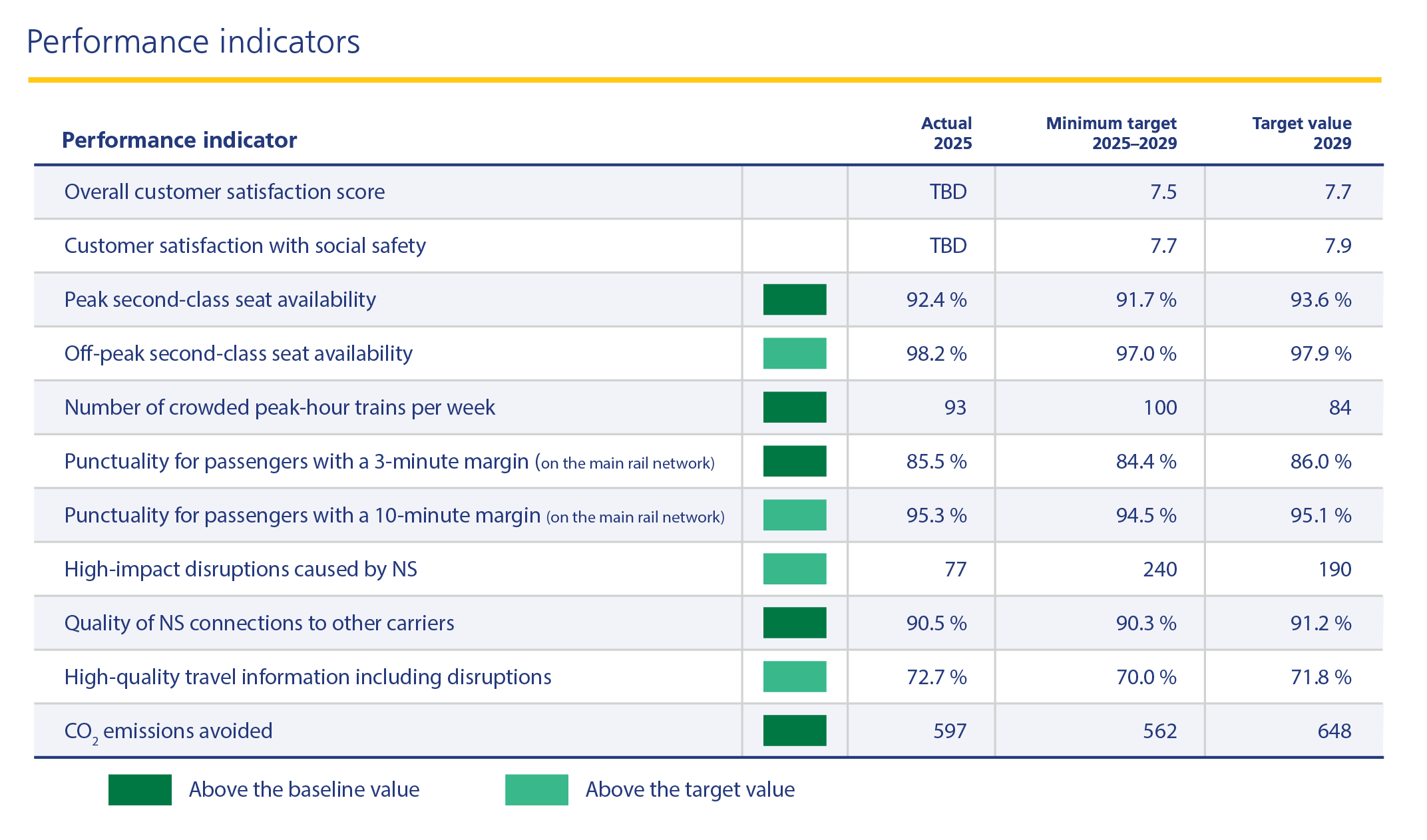
Information on most of our performance indicators can be found below. You can read more about 'Customer satisfaction with public safety' in the chapter 'Safe travel and work'.
Overall customer satisfaction score
The overall customer satisfaction score shows how passengers rated our performance over the past year. We do not measure the overall customer satisfaction score ourselves, but instead using the Public Transport Customer Barometer (OVBK). The figure for 2025 will be published in the first quarter of 2026, which means that we are unable to include it in this report. We have agreed with the Ministry of Infrastructure and Water Management that our average customer rating must be at least 7.5. We do know that the 2025 half-year overall customer satisfaction score was 7.8.
Seat availability
There are two performance indicators when it comes to seat availability: peak second-class seat availability and off-peak second-class seat availability. These PIs give an indication of the probability that a passenger boarding an NS train during peak or off-peak hours was able to sit for the entire journey. Particularly in the first six months, our trains were more likely to run according to schedule. This ensures a greater chance of finding a seat. We did experience more train cancellations in the autumn; however seat availability was still maintained. Overall, off-peak seat availability was high, despite regular crowding on weekends due to large-scale gatherings such as major events and demonstrations. Examples include Sail, the Dutch Grand Prix and the Red Line demonstrations.
We achieved the minimum values for both indicators. Off-peak second-class seat availability was also above target. Good for our score, but even better for passengers who were more likely to find a seat.
Number of crowded peak-hour trains per week
The rush hour is busy. After the COVID-19 pandemic, many people have embraced working from home. When they do travel by train, it is mainly on Tuesdays and Thursdays. On these days, peak times are much busier than before the pandemic. We refer to these as super-peak hours. NS works with a rolling stock plan, which we use in the timetable to match scheduled trains to anticipated demand. On the busiest days, Tuesday and Thursday, we provided extra trains. But trains can still be far too crowded during rush hour. For example, congestion can rapidly occur at local level when there are disruptions. In 2025, train routes via the High Speed Line (HSL) Schiphol-Rotterdam-Breda experienced more crowding than usual. Delivery of the ICNGs, rolling stock that is suitable for the HSL, has taken longer than desired. This has led to pressure on capacity at peak times and, when disruptions occur, trains on that route quickly become overcrowded. We understand that for our customers, every crowded train is one too many and it is not what we want either. Companies, schools, nurseries and outpatient clinics all open and close their doors around the same time. The logical consequence is rush hour traffic both on the roads and in the trains. As long as that remains the case, we need to be honest about the fact that sometimes a crowded train is unavoidable.
We have agreed a maximum number of crowded peak-hour trains per week with the Ministry of Infrastructure and Water Management. We stayed below that limit in 2025.
Punctuality for passengers with a 3-minute margin on the main rail network and Punctuality for passengers with a 10-minute margin on the main rail network
Passengers want to be able to count on NS. Timely departures and timely arrivals. For them, the punctuality of the train service is very important. We account for punctuality for passengers on the main rail network through two performance indicators. '3-minute main rail network' shows the percentage of NS journeys that were delayed by less than 3 minutes (less than 180 seconds) between a main rail network departure and a main rail network arrival station. '10-minute main rail network' means a delay of less than 10 minutes (less than 600 seconds). Both figures include train cancellations. We more than met the agreements for both criteria. We are proud that around nine out of ten passengers arrived on time. The situation on some routes requires improvement, which is something we are working on.
High-impact disruptions caused by NS
In an ideal world, the train service would never be disrupted. Unfortunately, however, our passengers (and we) face a difficult reality. The causes of disruptions are diverse: from a signal failure to a collision, from frost on the overhead wires to a broken-down train. Some of the disruptions can be attributed to us.
Disruptions vary greatly in terms of impact. The indicator ‘High-impact disruptions caused by NS’ shows the number of high-impact disruptions to the train service caused by NS. A disruption is high impact if the combined delay for all trains impeded by the disruption is at least 680 minutes. This includes the trains of other carriers, including freight operators, but excluding empty rolling stock and test trains. A number of minutes is allocated to each delayed train, cancelled train and diverted train to determine whether a disruption is high impact. It has been agreed with the Ministry of Infrastructure and Water Management that the maximum permitted number of high-impact disruptions attributable to NS is 240. We remained well below that number. The fact that we have addressed our shortage of main guards and drivers has certainly played a role. Such a shortage has had a negative impact on this performance indicator in previous years, with trains sometimes prevented from running due to lack of staff and delay minutes consequently stacking up. Now, the main cause of high-impact delays attributable to NS is train breakdowns. We are happy to have met the PI, but we are also aware that delays can have a huge impact on passengers. If you are on your way to an airport, an exam or a funeral, a delay can have severe consequences.
Quality of NS connections to other carriers
You prefer to sit quietly on the train until you reach your final station, letting the scenery pass you by, working, reading or having a chat. But sometimes you need to change trains. For many passengers, this is not the best part of their journey. Throughout the main rail network, NS operates 'long lines' wherever possible. This involves many trains running long routes. And almost 80% of our passengers do not need to change trains. And if you do have to, we make sure the transfer time is short. NS is not the only rail operator and our passengers sometimes continue their journey with a fellow carrier. It’s good if they can still catch their train when doing so. That is why we have the performance indicator ‘Quality of NS connections to other carriers’. This PI reflects how well NS facilitates transfers to trains of other carriers. A few factors affected this performance indicator, such as the lower levels of performance of some train series. Trains arriving at Amersfoort Central, for example, operate via the HSL. These trains are regularly delayed, potentially resulting in missed connections with RRReis trains to Barneveld and Ede-Wageningen. If you arrive late, it is likely you will have wait a while before you can continue your journey, depending on the time of day. The quality of connections is shown as the percentage of main rail network trains that arrive with a delay of less than three minutes (less than 180 seconds) at changeover stations. These are stations where it is possible to transfer to a passenger train covered by another concession. We also met this performance indicator.
Quality of travel information including disruptions
It has been said that to travel is to discover. The same applies to rail travel: there is always something to experience. Wonderful encounters, pleasant journeys and things that do not turn out as expected or planned. And when the latter happens, even the most seasoned passenger needs travel information. The performance indicator ‘Quality travel information including disruptions’ refers to the score for timely and correct communication of travel information in four categories. These are: track changes, delays, cancelled stops and perspective for action. As NS provides travel information for all carriers, the PI also covers communication about trains operated by companies such as Arriva or Keolis.
We met this performance indicator. One reason is that statistical analyses have made it possible to more accurately predict the duration of a severe disruption. At the same time, behind the good average results lie a few days when things really went wrong for passengers. For example, on 17 December, there was a completely loss of travel information on displays and in apps and in early September we experienced major delays in the journey planner during one of the busiest periods of the year.
CO2 emissions avoided
By CO2 emissions avoided, we mean the emissions our passengers avoided by choosing to travel by train instead of by car. We met this new performance indicator in 2025. For information on the performance indicator 'CO2 emissions avoided', see the Sustainability section. Further information on our operational performance can be found in our sustainability report.
Explanation and influencing factors
From scheduled works to protesters on the tracks. From the belated delivery of our New Generation Intercities to mild winters or summers without scorching-hot peaks. Numerous factors affect NS's performance. And we are not always, or sometimes not at all, able to influence them. Below is a list of examples of things that affect our performance.
Construction work
Just like the road network, the railway network needs to be maintained. It is as simple as that. Although the passengers affected now may struggle to see the positive side, in the long run everyone benefits. ProRail is responsible for the condition of the track and organises maintenance. Some of the work on the track is scheduled, for example because the rails need to be replaced. Last year saw another increase in activities compared to previous years. Scheduled maintenance still always disrupts journeys, but scheduled works usually allow NS to keep inconvenience to a minimum. By providing timely information, offering diversion routes by train. By arranging scheduled alternative transport where necessary and possible, and accommodating passengers at the station and pointing them in the right direction. We also take the work into account in the timetable.
But sometimes work is delayed by unexpected setbacks. And when this happens there are not always enough buses and drivers available to help our passengers continue their journeys. The result: disappointed or dissatisfied passengers and NS employees who want to help, but cannot do much more than absorb frustration. At Vught, where a temporary track had been laid, work fell behind schedule. Passengers had already faced an interruption of service for 16 days. If work is then delayed, this is an additional blow for passengers.
In Groningen, no train traffic was possible for 64 days. The station underwent a major renovation in preparation for the future. The alternative transport service mostly worked well. And yet it is not what you want for your passengers.
Infrastructure failures
Points failures, signal failures, broken rails, power failures, copper theft: unfortunately we could fill a bingo card. When a problem occurs, ProRail's contractors rush out as quickly as possible to fix things, but it always causes inconvenience to our passengers. On some routes more often than others. The HSL in particular was severely affected last year, as you will no doubt have noticed if you travelled frequently on this line. As was the Den Bosch-Utrecht route, which was affected by track instability. And you were also decidedly unlucky at Schiedam where a broken rail on a bridge resulted in a long period of complicated work. For passengers, infrastructure failures on their routes result in unexpected and unwanted adjustments to their schedules. The disruptions mean a less predictable product for them and for us.
The high-speed railway line (HSL)
The HSL is a whole different story. Built for very fast speeds. At least, that was the intention. But a number of viaducts have sustained damage and the railway track has shifted in several places. That means that we cannot operate at the speeds we would like to in these areas. ProRail does not expect the HSL to be fully restored before 2031. Temporary Speed Limits (TSLs) have been imposed on the HSL. We have incorporated these into the timetable as much as possible to provide passengers with a predictable train service. But the lower permitted speed means there is little we can do to respond to delays on the HSL. Delays also have a knock-on effect on other lines. After all, a train that arrives from the HSL with a delay needs to stop at a station at some point and thus gets in the way of other trains. Various works on the tracks at Rotterdam and Schiphol Airport – where we enter and exit the HSL – regularly caused delays that impacted on the HSL.
Collisions
Footage of the train driving directly into a lorry manoeuvring at a level crossing near Meteren on 30 October 2025 went viral. Fortunately the accident did not result in any fatalities, but what a scare, what a setback, what chaos. And a long aftermath in terms of track repairs. The route had to be closed to train traffic for several days. Our staff and our passengers regularly faced collisions and near collisions in 2025. Sometimes through pure bad luck, sometimes because someone thought they could just slip through the barriers. Some of the collisions involve suicides. In their desperation, people make a decision that forever marks the lives of their loved ones and others. Also those of our train drivers, main guards and Safety & Service staff: the other side of the coin of a wonderful profession. We are concerned about the increase in the number of confused people in the railway environment. This is a social problem that extends beyond the rail sector.
Strikes
There were strikes on a number of days last year in connection with the new collective labour agreement, at both regional and national level. Some of the regional strikes had national impact, for example a strike in Central Netherlands. A large number of the trains run through the province of Utrecht. National NS train traffic is also controlled from Utrecht. This means that such a regional strike brings train traffic to a halt across the country. On the strike days, significantly fewer or no NS trains ran in the Netherlands, which is extremely annoying for passengers as well as impacting other areas such as our customer satisfaction PI.
We concluded a new collective labour agreement retrospectively on 15 September, which will run until 1 March 2027.
Faults on the trains and broken-down trains
Our trains are subject to high usage. They undergo daily inspections at a service location. Once every three months, they go to a maintenance site for servicing. This is preventive, planned maintenance, for which the trains are scheduled to be withdrawn from service. The aim is to ensure that as few trains as possible are withdrawn from service at the same time, leaving as many trains – and therefore seats – for passengers as possible.
Despite all precautions, trains sometimes break down or develop a fault. The driver then calls the rolling stock control centre (MBN), the technical helpdesk. Together, they try to find a solution so that the train can continue its journey. But sometimes there is no immediate solution. When a train breaks down, it blocks the track. Resulting in delays for the following trains. Operated by us or by another carrier. Trains that have broken down are removed as soon as possible, but there is a high chance of a domino effect of delayed trains. This means that a broken-down train can easily result in a high-impact delay.
Two examples of such incidents. Due to a faulty air hose, a Sprinter (SLT type) was unable to continue its journey near Amsterdam Muiderpoort station in late November. The passengers were evacuated. The fault was high-impact, causing 1,336 delay minutes in total. In early December, there was a Sprinter (Flirt type) on the Wijchen-Zutphen route with a stuck brake. This disruption resulted in a total of 1,308 minutes of delay. High-impact disruptions are measured in minutes. But every minute counts for our passengers.
The Intercity New Generation (ICNG) has seen several software updates and modifications this year. This results in fewer fault notifications from components such as the interior doors and the inverters, which convert power from the overhead line to the right voltage for the other systems on the train. The performance of the ICNG is therefore gradually improving.
Clean trains
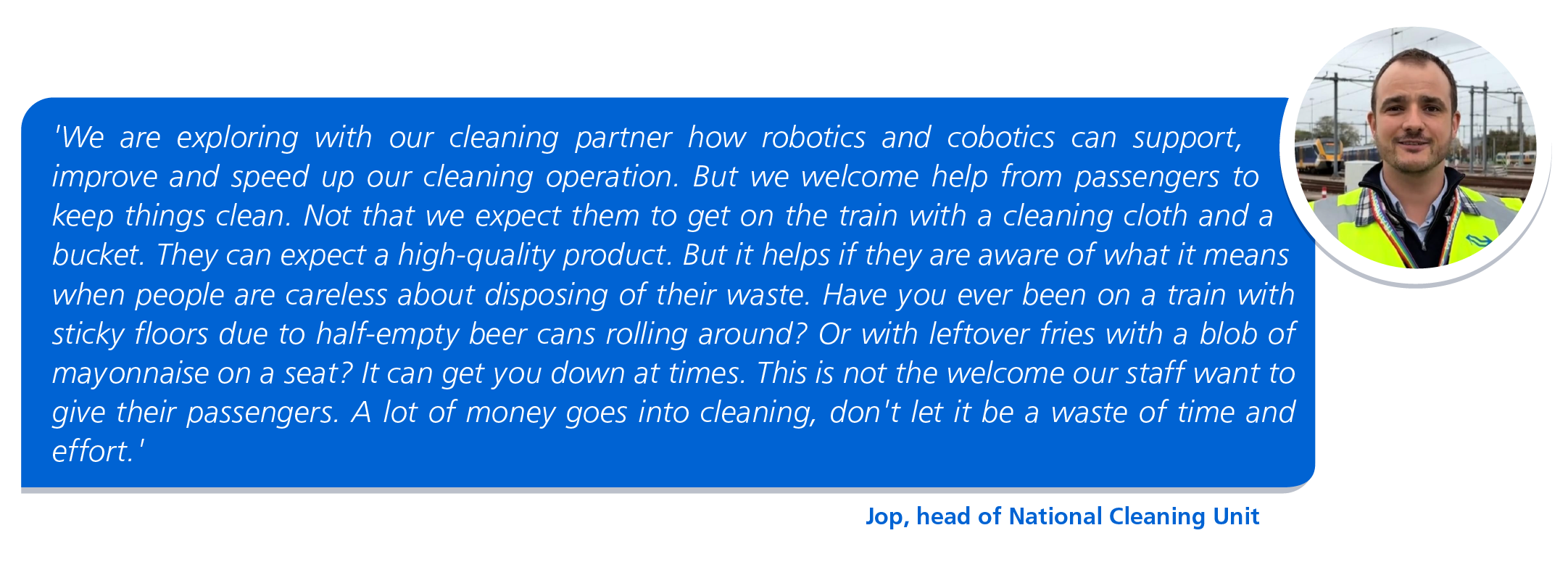
A clean train is an advert for NS. And cleaning helps ensure that the train reaches the end of its service life. Not to forget, whether trains are clean or not affects customer satisfaction.
The fact that a train gets dirty inside cannot be avoided. Use results in contamination. It’s natural. Your doormat at home and the hall sometimes also get dirty when you have just come in from outside. You will also find the occasional crumb on your dining room chair. With so many passengers, it is understandable that NS faces a difficult task in terms of cleaning.
The inside of each train is cleaned every 24-30 hours. That is the baseline, and this work is performed outside the timetable. The basic assumption is that the train will be visible clean at the start of the next new service. We also clean trains every day during the timetable. With turnaround cleaning at 21 stations, on-train cleaners on 11 routes and urgent cleaning when needed. The time we have for cleaning is limited, as the trains are needed for the timetable. We also have what is known as periodic cleaning four times a year. Similar to the old-fashioned home spring clean, the trains are cleaned from top to bottom and some undergo an extra deep clean.
That is the theory. The reality is that we operate too many dirty trains. And that is a source of huge frustration for us. There are all sorts of reasons why a train may not be as clean as we would like it to be for our passengers. But we understand that this does not make their experience any different.
Sometimes, for example due to a disruption, a train is not at the pre-designated location. Or, for instance, a train may suddenly be needed because another train has broken down. Or cleaning company staff are sick and no immediate replacement is available. How we can improve the cleaning process remains a matter of concern.
And then we also have the outside of the train. Weather conditions such as rain and storms often result in dirty trains. Not a pretty sight, of course, when you see such a powerful machine driving into the station covered in dirt. Drivers must be able to see clearly through their windows for safety reasons, but we would also like passengers to be able to do so through the compartment windows.
We have 13 train washing facilities in the Netherlands. Our trains received a wash every 32 days on average in 2025. In several locations, we were able to improve the quality of the cleaning operations. We also looked into the option of applying a coating to the trains to make them easier and faster to clean. NS will start overhauling its SLT-type Sprinters in 2026. We will take this opportunity to apply a coating to these trains as well. Approval was granted for investment in four new train washing facilities in 2024. Preparations for the associated tender were initiated last year.
We understand that passengers always prefer to be on a train that shines inside and out. As is the case for our employees. And we continue to do our utmost to make that happen.
A selection of our initiatives and campaigns
In 2025, our performance improved yet again compared to previous years. That didn't happen by itself: it took a lot of hard work. We are constantly doing our best to do our job a little better each time. And we are seeing the results. Read on for a few examples of what we have done.
2025 timetable
In 2025 timetable, we added more than 1,500 extra trains into the timetable. This improved seat availability. We also made more robust plans and incorporated works and temporary speed limits (TSLs) into our timetable wherever possible, making our train service more reliable and therefore more predictable for our customers. One example of where these measures were taken was with the long-term TSLs on the HSL, reducing their impact on the rest of the country. A more robust timetable also means that we were better able to cope with smaller disruptions than before. We have inserted extra minutes at some locations in the timetable. For example, at the stop at Amsterdam South. This allows more scope to catch up with delays and enables subsequently arriving trains to better avoid knock-on delays.
Shuttle system
The steam era is long since past and, like almost all large companies, we rely heavily on IT. To avoid becoming completely 'out of control' in the event of major IT disruptions, we have developed a shuttle plan. (Explained: the shuttle plan in practice) (new window) This is a contingency plan that involves launching a shuttle timetable in defined areas as soon as we can. Enabling us to transport home passengers who are mid-journey and in danger of being stranded. It is good to have the plan in place, but we are also glad that we did not need to use it in 2025.
Smarter maintenance planning
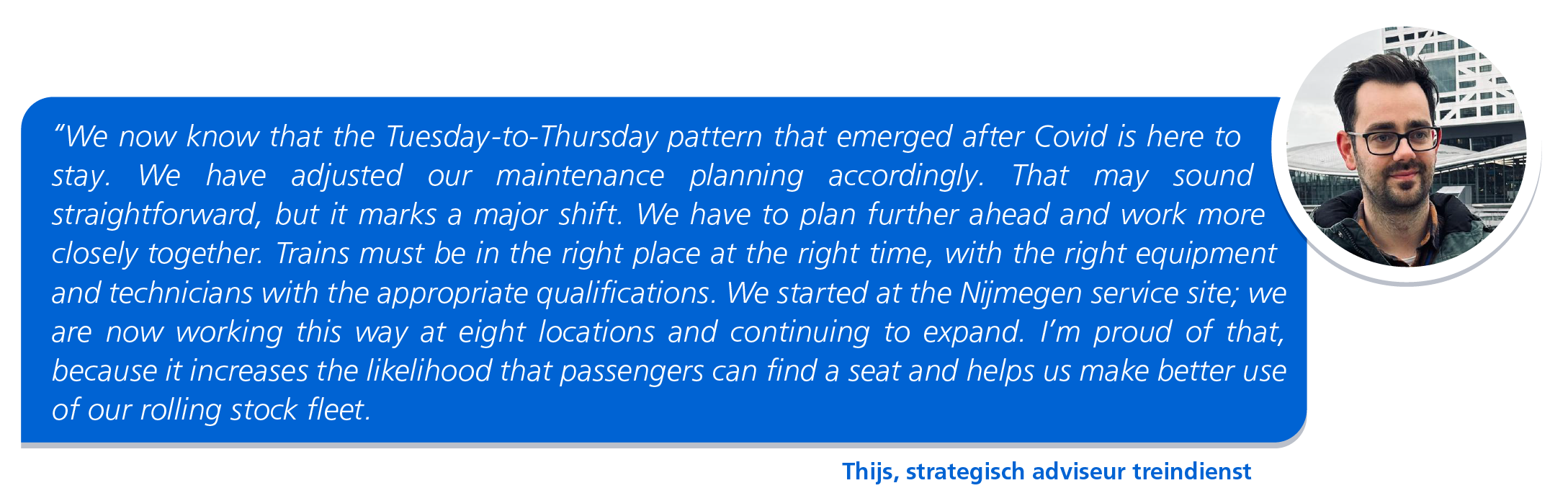
Train maintenance is an ongoing process. It is a precarious balance between when trains are needed in the timetable and when we need to maintain them. Another complication is 'super-peak hours': extreme rush hour traffic on Tuesdays and Thursdays. Ideally, we would like to deploy all the rolling stock in the timetable at these times. So we started planning smarter, spreading maintenance differently throughout the week. For instance, we do less maintenance on Tuesdays and Thursdays and more on the other days. That also means we make choices when it comes to repairs: if safety is not at risk, sometimes a train is repaired a little later. But, for example, if an air conditioner stops working during a hot period it will be dealt with immediately on Tuesday or Thursday. In 2025, NS withdrew an average of 13% of its trains each day for maintenance, repairs and refurbishment. This meant the average withdrawal was 2% lower than in 2024.
NS Price Time Deal
In 2024, we introduced the NS Price Time Deal, which you can purchase online. Essentially: the earlier you book, the higher the off-peak discount. Up to 60%. We continued to develop the NS Price-Time Deal in 2025. Since mid-2025, young people up to the age of 18 receive an additional 20% discount on top of the regular NS Price Time Deal discount. Another step we took was to focus discounts even more on certain less busy routes. We also experimented with discounts at the margins of rush hour. More than 20% of passengers with a NS Price Time Deal ticket for the margins of rush hour reported taking an earlier or later train than they would have done without these discount tickets. Sales of NS Price Time Deals have grown compared to 2024. The aim of these tickets is to encourage passengers to opt for a less busy train. In addition to the lower price, passengers have a better chance of finding a seat in these trains.
Converting first class
In spring 2025, we started converting some of the first-class compartments into second-class compartments. This work is being carried out on 190 Sprinters. The conversion will add 3,580 extra second-class seats. NS anticipates that enough seats will be left over for passengers who want to travel first class, even during rush hour. While the first-class option is popular on long-distance Intercity trains, only 10% of first-class seats in Sprinters are occupied on average during rush hour. The conversion will achieve a balance between first class and second class that better reflects current travel behaviour. The trains undergo conversion work outside rush hour when they are not needed in the train service. The affected trains are the Flirt, SNG and SLT type Sprinters. NS expects all 190 Sprinters to be updated by summer 2026.
Avoiding peak times
For many years, September has been the busiest month for NS. We took this opportunity to point rush-hour passengers towards slightly less busy trains, where they have a better chance of finding a seat. There are many crowded trains for which there is also a less busy alternative. Passengers often catch the same train out of habit and are sometimes not aware that a train just before or just after their regular departure time is less busy. We listed the busiest trains for passengers alongside an alternative, also stating that trains are busiest on Tuesdays and Thursdays. We also drew attention to the crowding indicator in the NS app, which give passengers an idea of the level of crowding on the train they plan to take. If a small proportion of passengers choose a different train in future, many passengers will have a better chance of finding a seat. Last autumn, NS extended rush-hour trains throughout the country wherever possible. Of course, we also once again asked our own employees who do not work according to a rota to avoid the busiest peak times. By travelling at slightly different times or working from home by mutual agreement. Colleagues responded to this request, helping to alleviate some of the 'rush hour burden' on the trains to Utrecht Central.