Sustainability
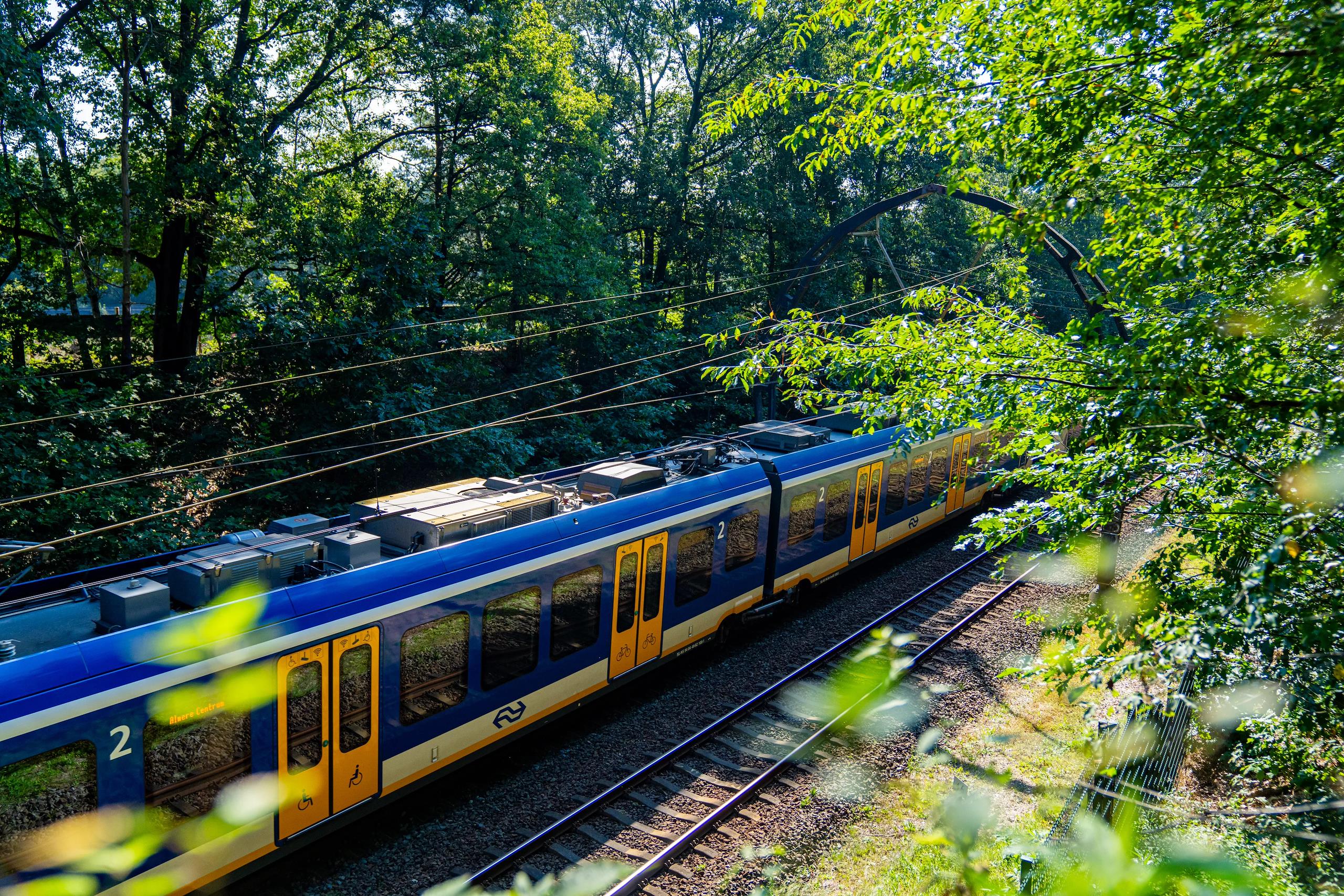
Our trains have been running on wind power since 2017 and also solar power since 2025. Everyone should be able to travel without burdening the planet. That is why we work every day to develop smart, sustainable solutions on and around the railways. We do so in collaboration with passengers, colleagues, authorities and partners, because sustainable, accessible mobility is something we can only achieve together.
In this chapter, you will find a brief overview of the key results we achieved in the area of sustainability in 2025. For detailed figures, underlying methodology and full scope 1, 2 and 3 information, please see the .
Three key focus areas: fossil-free, circular and green
Our approach revolves around three key focus areas: fossil-free, circular and green. That means saving energy where we can, generating more energy ourselves, and procuring the remaining energy in a sustainable way. It also means making economic and smart use of materials, and investing in a healthy, green environment at and around our stations. Continuing to build a future-ready railway one step at a time.
Our passengers avoided a total of 597 kilotonnes of CO2 emissions in 2025 by choosing to travel by train instead of by car. We are reporting on this 'CO2 emissions avoided' indicator for the first time to provide insight into NS's contribution to reducing emissions in the Netherlands. This is a performance indicator specified in the concession.
Zero-emission
At NS, sustainable travel largely comes down to smart energy use. We focus on three things: using less energy, generating as much green energy as possible ourselves and purchasing the rest from renewable sources. By doing so, we ensure that our trains and buildings are less and less dependent on fossil fuels and that we remain on track to achieve a zero-emission NS by 2050.
Energy use
NS’s energy consumption in 2025 remained roughly the same as in 2024 at 4.6 million gigajoules, whereas the number of passenger kilometres increased (2025: 16.5 billion, 2024: 16.1 billion). At 68.4 Wh/km, energy consumption per passenger-kilometre was therefore lower than in 2024 (69.6 Wh/km). NS is a major consumer of energy, particularly when it comes to running trains. Our train drivers are therefore trained to adopt energy-efficient driving practices by reducing speed earlier and accelerating slowly. Information on energy-efficient driving practices is also displayed in the cab. Another thing we do is to ensure that trains are parked in a way uses as little energy as possible. This helped to reduce energy consumption per passenger kilometre.
CO2 emissions in 2025
When measuring CO2 emissions, we distinguish between scope 1, 2 and 3 emissions.
Scope 1: emissions we cause ourselves, such as gas-fired heating in buildings.
Scope 2: emissions generated in the production of the energy NS uses. This includes the electricity we buy for our trains and buildings. We calculate scope 2 emissions in two ways: 1. location-based, where we calculate emissions based on the average available electricity in the Netherlands, without distinguishing between green and grey contracts; and 2. market-based, where we take into account the contracts NS has entered into for the purchase of electricity, including guarantees of origin that prove the electricity was generated from renewable sources.
Scope 3: emissions generated by the activities of others, e.g. in the manufacture of train components or building materials for station renovations. This includes replacement bus services.
Our total CO₂ emissions, in other words location-based scope 1, 2 and 3 combined, were 94 kilotonnes lower in 2025 than in 2024.
The new performance indicator 'CO2 emissions avoided' shows how many kilotonnes (1,000,000 kg) of CO2 emissions were avoided in total. These are the emissions avoided due to passengers - who can choose between travelling by train or by car - taking the train, minus the CO2 emissions in NS's operations and in the supply chain.
In 2025, a total of 597 kilotonnes of 'CO2 emissions avoided' was achieved in this way. This is equivalent to flying around the earth almost 100,000 times.
Energy and CO2 emissions: an overview
|
Energy and climate results |
Unit |
2025 |
2024 |
|
Energy |
|||
|
Total energy consumption |
GJ |
4.6 million |
4.6 million |
|
Share of renewable electricity in traction |
% |
100 |
100 |
|
Share of renewable energy in NS’s total consumption |
% |
96.5 |
96.3 |
|
Emissions |
|||
|
Total CO2-emissions (market-based) |
kilotonnes of CO2 |
440 |
474 |
|
Total CO2-emissions (location-based) |
kilotonnes of CO2 |
722 |
816 |
|
Emissions per passenger kilometre |
|||
|
Traction: trains (market-based) + replacement transport |
grams of CO2/km |
0 |
0 |
|
Total emissions: scope 1 + 2 (location-based) + scope 3 |
grams of CO2/km |
44 |
51 |
Generating energy
We use our own roofs and land to generate increasing amounts of renewable energy. In 2025, our solar panels generated 1,548 MWh of green electricity – well above last year's figure (1,002 MWh). Over 3,000 new solar panels were added to our workshop in Berkel-Enschot in 2025. We are also looking at how to store energy so that we can use it when there is no sun or wind. Making our energy supply cleaner and more stable.
Purchasing energy
We use our own buildings and land to generate energy from wind and the sun. The energy we purchase when there is no wind or sun comes with Guarantees of Origin (GOs): certificates that show the electricity was generated from renewable sources. By taking these measures we are playing our part in the purchase of fossil-free energy within public transport and taking clear steps towards our ambition for 2040.
Circularity at NS
Circular operations mean minimising the use of primary raw materials, optimising the use of materials and creating as little waste as possible. This ensures that the raw materials we use last as long as possible and are not lost prematurely.
Measuring circularity
We measure the circularity of purchased and outgoing materials based on inflow and outflow. NS's inflow includes all physical goods and resources that enter the organisation and of which NS becomes the owner. We aim to ensure a circular inflow as much as possible by opting for recycled, used and renewable raw materials. When it comes to outflow, we distinguish between different ways of managing waste. We consider prevention, reuse and recycling as circular outflow. We aim to ensure a circular outflow as much as possible. Energy from incineration and landfill fall under linear outflow.
Using fewer new raw materials
We take care to ensure that new trains and components are built as sustainably as possible. For example, the design of the Double Decker New Generation incorporates many recycled materials, such as a 67% recycled aluminium shell. We request a materials passport for new trains so we know exactly where the materials have come from and how they can be reused later.
Economical use of materials on trains
In 2025, we collaborated with 'Strong by Form' as part of a pilot project to develop a circular, lightweight train ceiling made of wood. Not only is this good for the environment, but it also reduces the amount of aluminium, a scarce raw material, that we need to use. This is one example of how we are using smart innovations and collaborating with others to develop a future-proof train.
Smarter and longer material use
We make sure trains and components can be used for as long as possible. Preparations for the modernisation of the first trains in the VIRM4 series started in 2025. We aim to reuse 99% of the old components during this process, of which 83% will be refurbished and immediately reinstalled, extending the lifespan of the trains. The remaining 16% will be used for a new purpose outside the train. We sell components and materials we no longer need through our upcycle shops and auctions, giving them a new life elsewhere. Over 6,000 components were reused in 2025 and 78 tonnes of material was repurposed through auctions.
Overview of circularity
|
Circularity |
2025 |
2024 |
|
Circular inflow |
14% |
17% |
|
Circular outflow |
63% |
56% |
Green
By adopting green business practices we contribute to biodiversity, a healthy environment, combating climate change, and climate adaptation. Together with ProRail and municipalities, we are ensuring that there is more, and more biodiverse, nature at our stations and workplaces. But we are also taking other steps, such as working on a larger vegetarian and vegan range in our shops and company canteens.
Nature around stations
It is important to us that our stations are not only functional, but also healthy and pleasant places to spend time. That includes nature and biodiversity near the stations. We employ environmentally friendly grass mowing practices, sow native flowers, and plant perennials and trees. To create a pleasant habitat for insects and birds, we install insect hotels and nesting boxes, such as at Driebergen-Zeist station. We planted succulents (sedum) on the roof of the new train wheel repair facility in Leidschendam. These keep the roof cool in summer, as well as relieving pressure on the sewer system by collecting rainwater.
Larger plant-based offering
Plant-based food is becoming more and more popular and is better for the environment than meat and dairy. Among other things, it reduces CO2 emissions. NS therefore wants to increase the plant-based offering in station shops. We also imposed requirements on the percentage of plant-based protein in our corporate catering tenders in 2025, which we aim to increase from 46% to 80% between 2025 and 2030. We performed a baseline measurement for our own retail chains and set an ambition for 2030.
We are also expanding the plant-based offering in our shops so that people can make more sustainable choices. Just one more way in which we are contributing to a sustainable world.