Circularity and material use
As a shared transport provider with an extensive procurement portfolio, NS plays a role in promoting the transition to a circular economy in the Netherlands. Linear use of materials and raw materials leads to use of finite resources, greenhouse gas emissions and waste generation. Scarcity of critical raw materials and rising prices emphasise the need to use materials and resources more efficiently. Circular material use, aimed at maximising lifespan and encouraging reuse, is therefore essential.
The material theme 'Circularity and material use' incorporates the sub-themes 'Material inflows and material use' and 'Material outflows and waste':
|
Material impacts, risks and opportunities |
Value chain |
Policy |
Action plan |
|
|
Sub-theme: Material inflows and material use |
||||
|
The impact of the use of materials and raw materials in NS's operations on the availability of materials, raw materials and critical raw materials |
Positive and negative impact |
Upstream and own operations |
|
|
|
The risk of scarcity and rising prices of critical raw materials that are essential for the production, operation and maintenance of trains |
Risk |
Upstream |
|
|
|
Sub-theme: Material outflows and waste |
||||
|
The negative impact of the amount of linear waste released in our operations on emissions and availability of materials and raw materials |
Negative impact |
Own operations |
|
|
Material impacts, risks and opportunities
Impacts
The impact of the use of materials and raw materials in NS's operations on the availability of materials, raw materials and critical raw materials is twofold. NS has a negative impact due to the amount of materials and raw materials required for its operations. On the other hand, NS has a positive impact by reducing the use of new raw materials and materials through overhaul, repair and reuse of rolling stock, train components and the sale of rolling stock, train components and materials.
NS has a negative impact on emissions and the availability of materials and raw materials due to the amount of linear waste generated at stations, including consumer waste, at workshops and in offices.
Risks
For NS, there is a risk of scarcity and rising prices of critical raw materials that are essential for the production, operation and maintenance of trains.
Policy
NS's business model is in line with the principles of a circular economy. NS encourages the shared use of means of transport by offering shared mobility in the form of trains and public transport bicycles. The ambition to attract more rail passengers contributes to more efficient use of mobility infrastructure. NS is also committed to increasing the circularity of its operations and its own products.
For NS, circular operations mean minimising the use of new and existing primary raw materials, maximising the use and reuse of our materials and not creating any waste or residual waste. We follow this approach in our offices, workshops, stations and trains. To achieve this, we focus on the NS ‘Trias Circular’, which is central to our circularity policy.
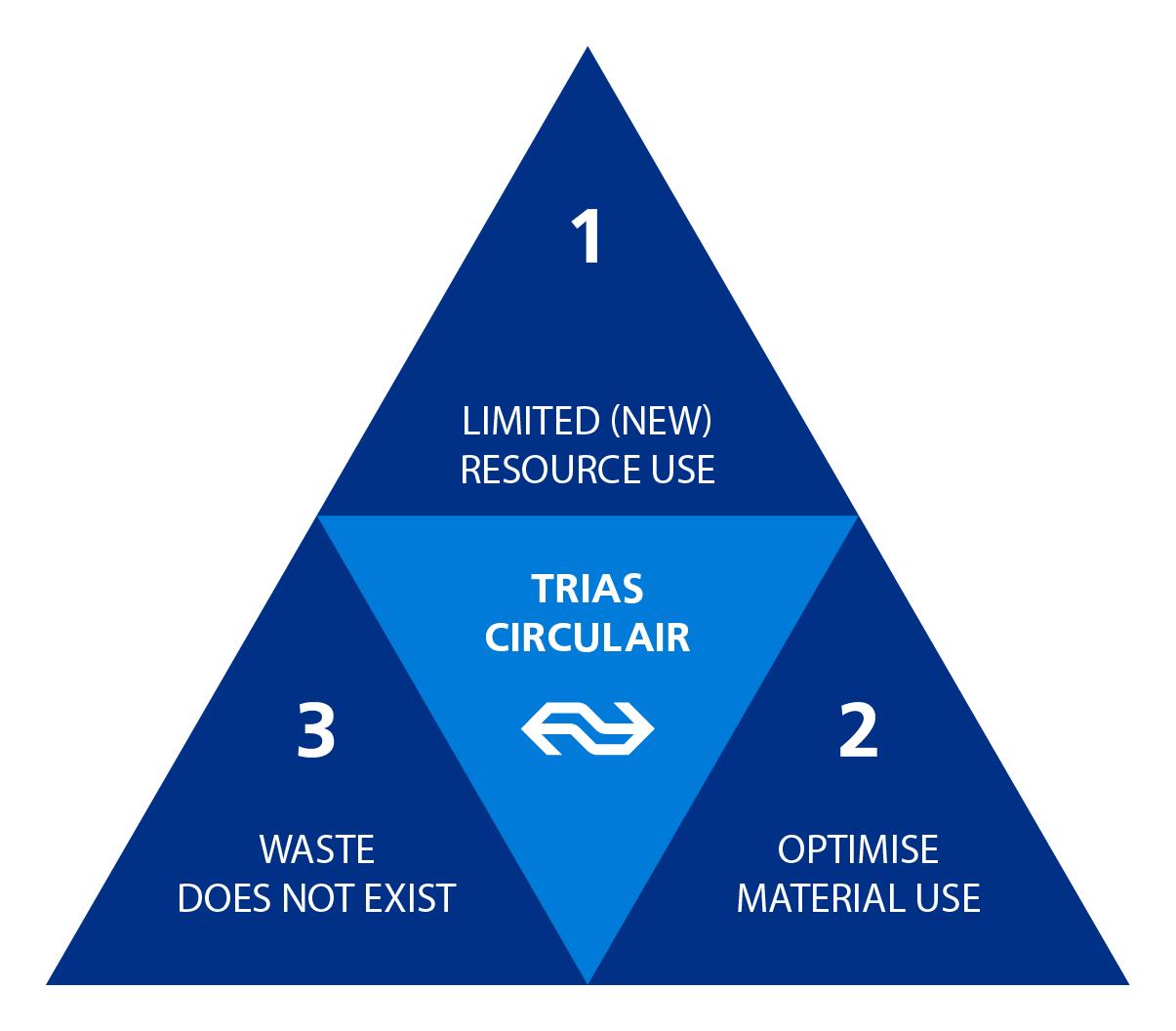
The supply chain of goods and capital goods contributes significantly to NS's impact on the use of raw materials and the circular economy. NS is therefore also committed to socially responsible commissioning and procurement (SRCP). Circular design and procurement are integrated into the NS SRCP policy. This policy encourages a number of circular procurement practices with the aim of reducing dependence on raw materials and promoting circularity. Examples include the transition from possession to use, the use of previously used or regenerative bio-based materials, circular design and extending the lifespan of products.
NS's circularity policy pays explicit attention to critical raw materials. These are essential natural resources for our trains and operations, the availability of which is uncertain. This is partly due to scarcity, the concentration of extraction in some countries outside the EU, and possible disruptions due to natural disasters or conflicts. To mitigate these risks, NS is committed to the transition to a circular economy. This helps reduce pressure on raw materials, makes our supply chains more resilient and makes us less dependent on critical raw materials.
Inflow versus outflow
By inflow, we mean all physical resources entering our company. This includes new trains and spare parts, maintenance supplies, company clothing and IT hardware. Inflow is circular if it does not contribute to resource depletion, for example because it has been used before (reused or recycled) or because it is replenished (from a sustainably managed biological source).
By outflow, we mean physical assets leaving our company and the waste thrown away by passengers on trains and at our stations. Outflow is linear if the materials are landfilled or incinerated and circular if the materials are not lost but reused. This only works if it is technically possible to reuse, convert, recycle, ferment or compost those materials and if there is a party that is able and willing to do so.
For definitions of inflow and outflow we align with the World Business Council for Sustainable Development’s Circular Transition Indicators (CTI) framework.
Material inflows and material use
Actions, indicators and targets
Actions
Reduce the use of primary raw materials
We are economical in our use of raw materials and our products. Through circular and material-efficient design and procurement, we aim to use materials more efficiently, reduce the use of primary raw materials and prevent waste in the future. We aim to increase circular inflow as much as possible by opting for recycled, used and renewable (‘bio-based’) raw materials. Where possible, we work with suppliers and supplier chains to make products circular and extend their lifespan. Circularity is routinely included in relevant procurement processes, such as tenders, to select sustainable products and reward suppliers for making them more sustainable.
When purchasing new trains, NS requests a material passport. This passport gives us insight into the origin of raw materials used to build the train and the reusability of materials at the end of their service life. In the design and procurement phase, we focus as much as possible on rapidly renewable, used or recycled materials. We also limit the weight of the trains so that less material is needed to build them and less energy is needed to run them. We select circular materials that do not contribute to resource depletion and that can be dismantled and reused after the train’s service life. As a result, we both use fewer new materials and avoid waste at the end of the train's service life.
The Double Decker New Generation (DDNG) is the world's first train to come with a material passport. During the design phase, we worked with train builder CAF to design the train in a circular and modular way. For example, the wheels and axles are made from 100% recycled metal and the shell is made with recycled aluminium (67%). This limits the use of primary raw materials and reduces CO₂ emissions during the production phase of the train. We have also focused on using less material through critical design, 3D printing and the use of honeycomb structures.
In the tender for the new Flirt Flex trains, awarded in 2025, circularity was also an integral part of the requirements set and the award process. A material passport will be drawn up for the newly built Flirt Flex trains, as with the DDNG. The design phase will involve working with Stadler on a modular and circular design of the train to avoid waste in the future.
Strategic and critical raw materials
At present, not enough is known about many of the critical and strategic raw materials coming into our company. This is because they often occur in small quantities in the purchased products, while inflow reports usually only include the main material types. However, we are making progress: starting this year, we have specifically asked our suppliers to include critical and strategic raw materials in their inflow reports. This gives us a better understanding of which critical and strategic raw materials are present in the products entering our company.
New trains contain large amounts of aluminium, a critical raw material whose long-term security of supply is not guaranteed. We therefore started looking for sustainable alternatives that are abundantly available and rapidly renewable. This led to a pilot of Woodflow: an innovative, lightweight 3D-produced wooden composite, which we use to develop a train ceiling. We demonstrated this wooden Woodflow train ceiling to the rail industry at the Railsponsible Event. This pilot project is an important first step to explore how scarce materials in trains can be replaced with more environmentally friendly, rapidly renewable raw materials, thus contributing to a circular and future-proof rail sector.
NS has placed the topic of critical and strategic raw materials on the agenda within the Circular Public Transport Covenant (CCOV), the partnership between public transport parties in the Netherlands. NS is also taking the initiative on this topic within Europe's Rail Joint Undertaking (ERJU), and we are working together on targeted projects. These partnerships are essential for jointly developing circular solutions, better managing the risks surrounding these raw materials and understanding which critical and strategic raw materials are indispensable for our trains and the sector as a whole. One concrete step NS has taken is the organisation of a workshop in late 2025 in collaboration with train builders, other carriers and experts from the Netherlands Organization for Applied Scientific Research. The workshop identified critical and strategic raw materials within the rail sector. This joint approach contributes to the sustainable use of raw materials and helps to safeguard the railways for the future.
Indicators and targets
To effectively manage and promote the circular and efficient use of materials, NS applies a permanent ‘inflow measurement’ method that allows us to analyse the volume and composition of the materials we procure. NS measures the circularity of purchased materials by measuring the mass of different types of material purchased and then determining the extent to which it contains circular raw materials. For inflow with an unknown mass, we make an estimate based on the average mass per euro of the purchasing category to which the inflow belongs. We calculate the circularity of inflow based on the CTI classifications 'non-virgin' (raw materials that have had a previous use) and 'renewable' (organic raw materials that are not depleted).
Circular content is determined based on information from suppliers and publicly available product information. For purchased goods for which no circularity information is available, it is conservatively assumed that the raw materials are not circular. No market averages for circular content are therefore used.
Measurable annual targets have been set for circular inflow by all NS business units until 2030, which add up to the following NS-wide targets for the percentage of circular inflow:
|
Indicator |
Unit |
Realisation in 2025 |
Realisation in 2024 |
Target in 2025 |
Target in 2030 |
|
Share of circular inflow |
% |
14% |
17% |
21% |
25% |
|
Unit |
2025 |
2024 |
|||
|
Total inflow |
tonnes |
63,202 |
71,500 |
||
|
Inflow measured |
tonnes |
36,913 |
14,318 |
||
|
Share of inflow measured |
% |
58% |
20% |
||
|
Critical materials measured |
tonnes |
34 |
360 |
||
|
Strategic materials measured |
tonnes |
63 |
103 |
NS's total inflow in 2025 was an estimated 63,202 tonnes (2024: 71,500 tonnes). The main categories are:
Trains: new rolling stock and train components (in 2025 mainly ICNG; approximately 8,000 tonnes)
Retail range: mainly food and beverages sold in NS Retail's various retail chains (around 25,000 tonnes)
Building materials: for construction and refurbishment projects (approximately 22,000 tonnes)
In 2025, 36,913 tonnes of inflow was measured (2024: 14,318 tonnes). The proportion of measured inflow increased to 58% (2024: 20%), mainly due to the availability of more data from the retail range, inflow of new rolling stock and the construction of the rolling stock concourse at our train modernisation site in Haarlem. Supplier delivery of inflow information is also included in more and more procurement contracts.
Of the incoming materials with a known composition (inflow measurement), 14% were circular (2024: 17%). Realisation in 2025 was below our stated target (21%). This is mainly due to the availability of more data from the retail assortment, where it is proving challenging to achieve a high proportion of circular inflow. The Haarlem construction project also has a relatively low proportion of circular inflow.
NS's 2025 inflow had a known critical material content of 34 tonnes (0.05%). This was mainly aluminium used in the train shell and train windows. NS's 2025 inflow had a known strategic material content of 63 tonnes (0.09%), mainly copper in carbon contact strips and cabling. NS uses the fifth list of Critical Raw Materials, published by the European Commission in 2023, to monitor and minimise the use of scarce and strategically important materials within its operations.
Material outflows and waste
Actions, indicators and targets
Actions
Optimising the use of materials
We are economical in our use of our materials and trains. We are committed to the maximum use and reuse of materials through effective maintenance and timely repairs so as to extend their service life. This prevents waste and allows us to use and reuse our products and components longer and more efficiently.
This year, NS train modernisation started the Pre Try Out (PTO) of modernising the first 20-year-old VIRM4 train so that it can carry passengers for another 20 years. The aim is to give a second lease of life to 99% of old train components, 83% of which will be refurbished and reinstalled in the upgraded trains. In 2026, we will start serial production to modernise the entire VIRM4 fleet.
In our repair and maintenance work, we aim to extend the life of train components. In 2025, 25% of train components used, excluding fasteners such as bolts and nuts, were ‘reuse components’. These reuse components are repaired or reconditioned when defective instead of being discarded and replaced with new ones. We are further exploring the potential to convert consumable components to reuse components in the future.
Eliminate waste
We try to avoid waste by optimising our use of materials. NS sees waste as a valuable raw material. We first see if we can fully reuse the product. If this is no longer possible, we ensure that materials are given a high-quality new purpose. If possible, we close the loop within NS through reuse and upcycling or recycling. We analyse which components can be reused within our organisation and offer residual materials to third parties through various channels. Materials that can no longer be reused or sold are recycled by our waste processor wherever possible. We optimise waste collection points at NS locations to ensure better and more efficient waste separation.
Together with ProRail and the Ministry of Infrastructure and Water Management, NS Stations is working on the ambition of Zero-Waste Stations by 2040 to increase the circular outflow of consumer waste at stations. In 2025, 35% of consumer waste at stations was processed in a circular way (2024: 33%). Last year saw the adoption of a new roadmap setting out improvement measures until 2030, for instance to make packaging materials more sustainable and improve waste separation at source.
Steps have also been taken to improve waste separation at NS offices, canteens and accommodation this year. For example, new waste separation bins have been installed, promoting recycling and enabling better separation and processing of waste streams. A total of 37% of office outflow was processed in a circular way in 2025 (2024: 34%).
Since 2024, NS has asked colleagues and visitors to bring their own cup to NS locations for coffee or tea. NS stopped providing reusable plastic cups to those who forget to bring a cup in 2025. This is one of the ways we are encouraging sustainable reuse and preventing waste.
Outflow of trains
When a train series nears the end of its service life and is no longer needed for the timetable, it is preferable to sell the train on the second-hand market. For example, we delivered six locomotives, one 'Koploper' type Intercity train (ICMm) and three ICE trains to external parties in 2025.
Before we sell, we look at which components we can still use to maintain our remaining trains. In 2025, we managed to use over 4,400 components from ICMm trains for our own internal use. If selling the train proves impossible, for example due to serious damage, or if there is no interest in the market, we offer components we no longer need for reuse by third parties. One of the ways we do this is through a 'harvest book' that we share with market parties and our upcycle partners. We dismantled and sold around 1,600 train components to third parties for reuse in 2025 with this approach.
Finally, we ensure that residual materials from trains that cannot be reused are carefully separated and recycled to the greatest possible extent. When dismantling ICMm coaches, we sustainably retained over 97% of materials in the cycle in 2025.
NS Upcycle shops and NS auctions
In 2025, we opened pop-up NS Upcycle shops at Rotterdam, Amsterdam Central and Utrecht Central stations. In these shops we offer unique collector items from old trains, such as emergency brake triggers and train bins. We also sell NS upcycle products made from train components. Together with our upcycle partners, we provide a platform for circular design and show that there is no such thing as waste. We inspire visitors to see 'waste' as the starting point for something new. This way, we contribute to reducing waste and raise awareness of sustainable recycling.
Through 13 auctions, we found new uses for old or surplus NS materials in 2025. In total, hundreds of items (and 78 tonnes of materials) found a new purpose in this way.
Indicators and targets
NS uses the Lansink's Ladder waste hierarchy for outflow. This ladder distinguishes between different ways of managing waste. Prevention and reuse have the highest priority, followed by recycling. Incineration with energy generation, incineration without energy generation and landfill are considered linear outflows by NS.
With the 'Circular outflow' indicator, we focus on increasing the circularity of outgoing materials. Measurable annual targets have been set for circular outflow by all NS business units until 2030, which add up to the following NS-wide targets for the percentage of circular outflow:
|
Indicator |
Unit |
Realisation in 2025 |
Realisation in 2024 |
Target in 2025 |
Target in 2030 |
|
Share of circular outflow |
% |
63% |
56% |
64% |
82% |
In 2025, we disposed of 18,259 tonnes of materials. Of the materials disposed of, 63% were circular (2024: 56%). This increase in the circular share is because more and more materials are being repurposed and reused.
The composition (table) and processing methods (diagram) of the outflow are:
|
Total outflow |
% circular |
|
|
Residual waste |
7,003 |
19% |
|
Metal |
3,334 |
99% |
|
Miscellaneous reuse |
3,047 |
100% |
|
Wood, paper and cardboard |
1,289 |
94% |
|
Oil (products) and sewage sludge |
1,155 |
76% |
|
Construction and demolition waste |
860 |
95% |
|
Swill and out-of-date products |
732 |
50% |
|
Solvents |
407 |
99% |
|
Plastics and packaging |
163 |
42% |
|
Miscellaneous |
269 |
61% |
|
18,259 |
63% |
Hazardous waste
In 2025, 992 tonnes of hazardous waste was disposed of, representing 5.4% of the total outflow (2024: 6.1%). This hazardous waste category includes contaminated water, mineral oils, paints and coolants. The lower percentage compared to last year is partly because no VIRMm trains were modernised in 2025. Of the hazardous waste, 87% (2024: 88%) is processed in a circular way. This year, the use of rinsing agents was critically reviewed and adjustments were made to reduce consumption. The paint process at NS train modernisation was also optimised by using a different brand and a more precise design. These measures collectively help to reduce hazardous waste.
Collaborations
Signing of the Circular Public Transport Covenant (CCOV)
In 2025, NS signed the Circular Public Transport Covenant. By taking this step, we underline our commitment to the transition to a circular economy within the Dutch mobility sector. In collaboration with other public transport parties and the Ministry of Infrastructure and Water Management, NS is working on the transition to circular public transport, with a focus on knowledge sharing and investment in research and innovation.
NS becomes a member of Dutch Association for the Circular Economy Association (NVCE)
The year 2025 saw the establishment of the Dutch Circular Economy Association, of which NS became a member. This strengthens our commitment to promoting circular business practices, as well as connecting us to a strong network of businesses working together towards a circular economy.