Travelling and working in safety
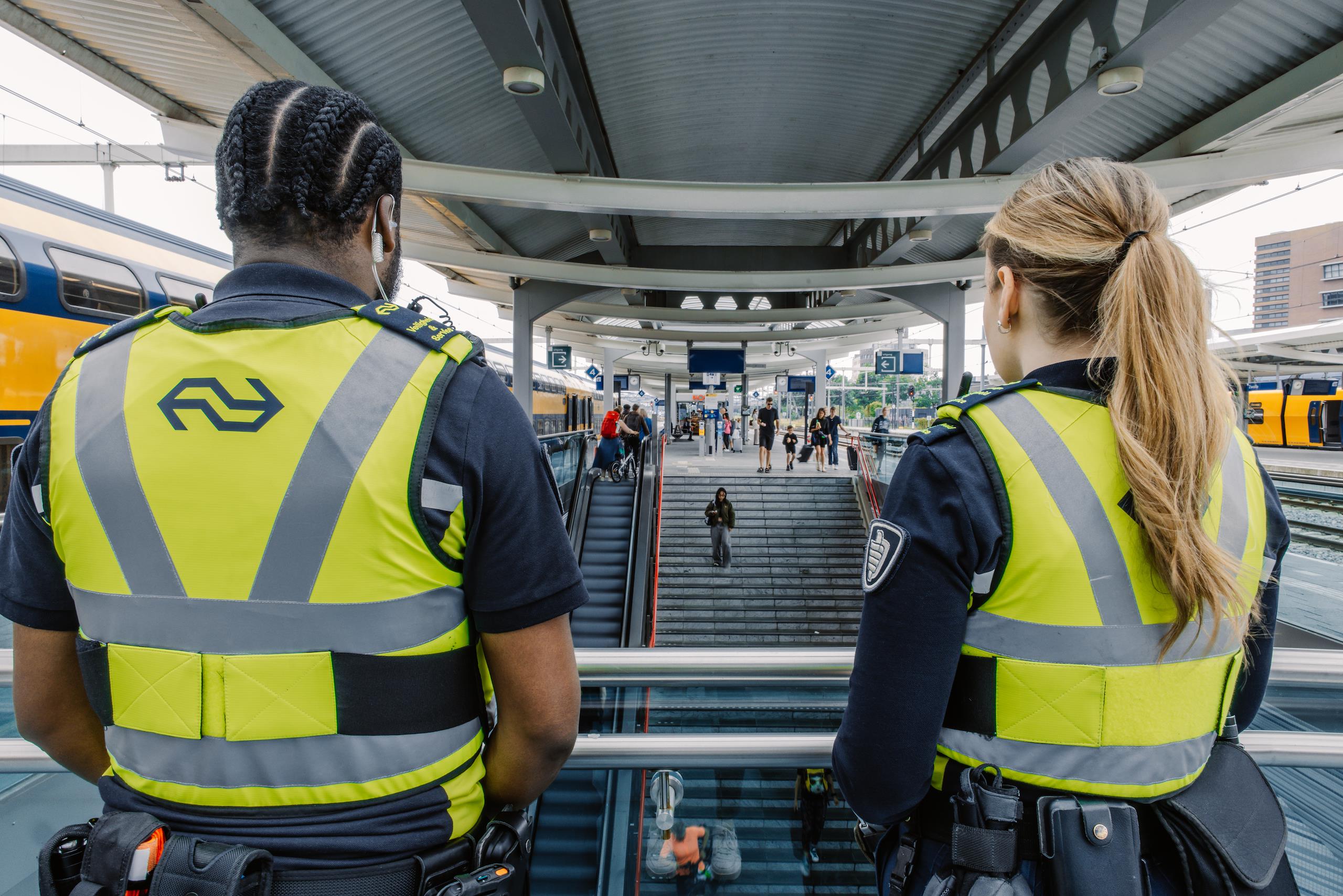
Public safety
The customer satisfaction score for public safety shows how our customers rate public safety. Customers are asked how safe they feel during their journey and at the station where they boarded. We do not measure the customer satisfaction score for public safety ourselves, but instead using the Public Transport Customer Barometer (OVBK). The figure for 2025 will be published in the first quarter of 2026, which means that we are unable to include it in this report. We have agreed with the Ministry of Infrastructure and Water Management that the average rating must be at least 7.7. Unfortunately, a half-year figure is not available for this performance indicator (PI).
It is important to us that everyone, both passengers and colleagues, feels safe, welcome and comfortable on our trains and at our stations. Sadly, public safety is not something that we can take for granted in today's changing world. Social tensions are evident among groups of passengers, troubled individuals and people with short fuses at our stations and on our trains. In that respect too, what happens within NS is a reflection of society. Unfortunately, we cannot change these developments on our own. But we are committed every day to ensuring the safest possible working and travel environment.
In 2025, the number of incidents involving aggression against colleagues rose again. The total increased from 1,095 in 2024 to 1,132 incidents, as we announced in February 2026. Any situation in which a colleague suffers threats or even injury is one too many. And these situations always make an impression. Being able to go home safely and unscathed at the end of your shift should be the norm.
In 2025, NS deployed additional Safety & Service (S&S) staff at high-risk stations and on high-risk route, and worked even more closely with police and security. We received permission from the Ministry of Justice and Security to launch a pilot in which S&S employees are allowed to carry a baton. Although this is something that we have always been reluctant to do, we now want to explore with colleagues whether this increases their safety in difficult situations. The pilot is expected to start in early 2026.
To combat fare dodging and associated aggression, the fine for travelling without a ticket was increased as of October. This was a decision made by the State Secretary for Public Transport and the Environment. The administration fee for late payment also went up. For major events (such as the Dutch Grand Prix and King's Day), we switched to 100% ticket checks where non-ticket holders were denied access to the trains. This proved effective in terms of both security and payment behaviour.
When passengers feel unsafe on the train and they cannot see a conductor, they can contact the NS Control Centre directly via WhatsApp. The number where they can reach the NS Control Centre (0613181318) is displayed in compartments. In 2025, a total of 4,196 calls were made to this number that were followed up by the NS Control Centre. The number of reports therefore remained roughly the same (2024: 4,308).
On Budget Day, the Ministry of Infrastructure and Water Management announced that it would be investing €20 million in improving public safety at stations and €12 million for the purchase of bodycams for NS senior conductors.
Railway safety
Every day, thousands of colleagues work to prevent accidents and reduce risks, both for passengers and their own colleagues. In 2025, NS was again awarded the Single Safety Certificate. Although this may sound technical, it specifically means that we comply with strict European train safety rules.
In this reporting year, the number of red signals passed without permission (signals passed at danger, or SPADs) was 40. In six cases the danger point was reached, but fortunately the situations did not end in collisions or derailments. A total of 125 railway safety incidents and 23 accidents were also reported: from accidents at level crossings to derailments, collisions and other incidents. Every incident is carefully investigated.
In 2025, the focus was on managing risk. We also paid close attention to safety culture and learned from practical experiences and periodic safety culture measurements.
Railway safety requires a joint effort. NS works closely with ProRail, other carriers and regulators, because success on the railways something that we need to work together to achieve. With this in mind, we take steps every day to make train travel as safe as possible for everyone.
Cybersecurity
A train journey does not only take place on the tracks, but also more and more in a digital environment. NS ensures that systems and technology are secure and closely monitors anything that could affect our digital environment. In 2025, we continued to develop our Cybersecurity Strategy so that we are prepared for today’s risks and threats.
That means we keep a close eye on digital risks and take measures where necessary, to ensure that systems operate safely for passengers and employees.
Four high-urgency incidents that could have been prevented occurred in 2025. Fortunately, these incidents did not have a major impact on our services. A test domain was not cleared in time. Once the domain was no longer being managed, other parties took it over and used it for links to other websites. This domain was for testing purposes only and did not access internal systems or passengers' data. No personal data was affected and services continued to operate as usual. The domain was immediately removed and we have tightened up the rules for test and temporary domains to prevent this from happening in the future.
A changing world brings changing threats. That is why we continuously learn from incidents, issue regular reports and work together to make NS ever more resilient to new threats. To keep rail travel safe for millions of passengers and colleagues.
Corporate Security
NS protects its property and assets and tries to create a safe working environment. We monitor our NS offices, workshops, warehouses, maintenance facilities and closed sections of stations remotely from two central Security Control Centres (SCCs) in Amsterdam and Utrecht. The use of cameras, intercom, alarm systems, sensors and access control allows us to act quickly when necessary. More locations were connected to the SCCs in 2025, further increasing coverage and impact.
Combating graffiti
Some see a train as a canvas for their artworks. We regard unsolicited graffiti spraying on our property as vandalism. And we like to keep our trains clean. In 2025, we continued to invest in combating graffiti on trains. We did so by working even more closely with parties such as the police and security. And through the more targeted use of dogs and their handlers, more sensors, improved camera systems and the use of more and improved data. It remains a costly 'cat and mouse game' with the graffiti sprayers. Although our efforts to combat graffiti have been successful when viewed over several years, there was 7.1% more graffiti last year compared to 2024 (but 24.8% less than in 2023). We removed 107,000 m2 of graffiti, the equivalent of 15 football fields, from trains in 2025. As part of the joint graffiti task force with our National Cleaning Unit, we continuously adapt our actions and measures to the current situation.
New legislation
NS prepared last year for the introduction of the new Critical Entities Resilience Act (Wwke). This Act is expected to enter into force in the second quarter of 2026 and is a Dutch translation of the European Critical Entities Resilience (CER) directive, which came into force in early 2025. The departments involved have taken a number of associated measures, including risk assessments at 13 critical NS locations. We also analysed the current situation with regard to physical security of technical IT rooms. Corporate Security has launched the Resilient programme, which will coordinate the various components of the Wwke and Cbw (Dutch Cybersecurity Act) with the aim of making NS compliant and increasing resilience.
Terrorism and extreme violence
NS is always alert to terrorism and other forms of serious and extreme violence. We conducted frequent small-scale exercises in responding to suspicious and threatening situations at a number of stations in 2025. Improvements have been made based on inspections and incident analysis, particularly in terms of awareness and knowledge of perspective for action and processing protocols among employees.
Sabotage was emphatically identified as a risk in 2025, including during the NATO summit, but also in the wake of incidents in Germany and Poland. Deliberate disruption of train services by activists standing on the tracks to draw attention to their cause is a new development. We witnessed this at The Hague Central station and at Amsterdam Central station. NS pressed charges against the perpetrators.
Eurostar security
In order to run the Eurostar to London, we must meet the security requirements set by the Channel Tunnel Authority. At Amsterdam Central and Rotterdam Central stations, we perform security checks of all London-bound passengers and their baggage, as well as our own employees.
The new terminal at Amsterdam Central was brought into operation in February 2025, and we are once again running direct from Amsterdam and Rotterdam to London. From February to September, three trains a day ran directly to London on weekdays. A fourth train was added in September. Since 1 January 2026, we have been running five direct trains to London a day in partnership with Eurostar.