Description of the organisation
NS provides services that go beyond trains. In all our activities, the primary focus is on our passengers. Our more than 21,000 employees work hard on this focus every day. Together with our public transport partners, we continually work to improve our service and performance levels.
Our mission ‘Together, we are making the Netherlands accessible in a sustainable manner – 'For everyone' serves as a compass for our strategy and guides how we, as a state-owned company, help to address social challenges. We help to bring people together and to ensure equal opportunities and a viable future for the world. We serve the public interest: we are here for the Netherlands.
Historical context
The oldest predecessor of NS is the Hollandsche IJzeren Spoorweg Maatschappij (HSM), founded in 1837. In 1938, HSM merged with the Maatschappij tot Exploitatie van Staatsspoorwegen to form Nederlandse Spoorwegen (NS). All shares came into the hands of the Dutch state. After decades of operating as a public company, on the government’s instigation NS split in 1995 into NS Group and the three 'task organisations' Railinfrabeheer, Railned and Railverkeersleiding (from 2003, the three continued jointly as ProRail). Since then, NS Group has operated as an independent company with a public shareholder, combining our social responsibility with entrepreneurship and innovation.
Group structure and activities
NS consists of several business units, including NS Operations (approximately 14,200 staff, on average, in 2025), Commerce & Network (approx. 850 staff) and NS Stations (approx. 3,600 staff, including retail and bike), plus central departments such as HR, Finance and IT (approx. 2,600 staff).
NS Operations
NS Operations is responsible for rail transport on the Dutch main rail network, including the high-speed line (HSL). NS International falls under NS Operations. This is where the employees work who enable our trains to travel from A to B in the Netherlands and across the border. They include train drivers, guards, mechanics and service staff, as well as the staff who work behind the scenes to help implement our timetables and manage operations during unexpected events.
Commerce & Network
At Commerce & Network (C&N), colleagues work on timetables, train formulas, customer service and marketing activities. This unit is responsible for ticket and season ticket sales both within the Netherlands and at international level. Commerce & Network also conducts NS satisfaction surveys among passengers and identifies areas for improvement.
NS Stations
NS Stations works in a high-quality network of 400 large and small stations and promotes area development initiatives around the stations. Together with ProRail, public authorities and carriers, NS Stations seeks to make passenger journeys and the time spent in and around stations as convenient and enjoyable as possible. In collaboration with local authorities, citizens and social entrepreneurs, we seek effective integration of our facilities in the station environment. All activities are designed to improve the passenger experience at the station and throughout the journey.
Management structure
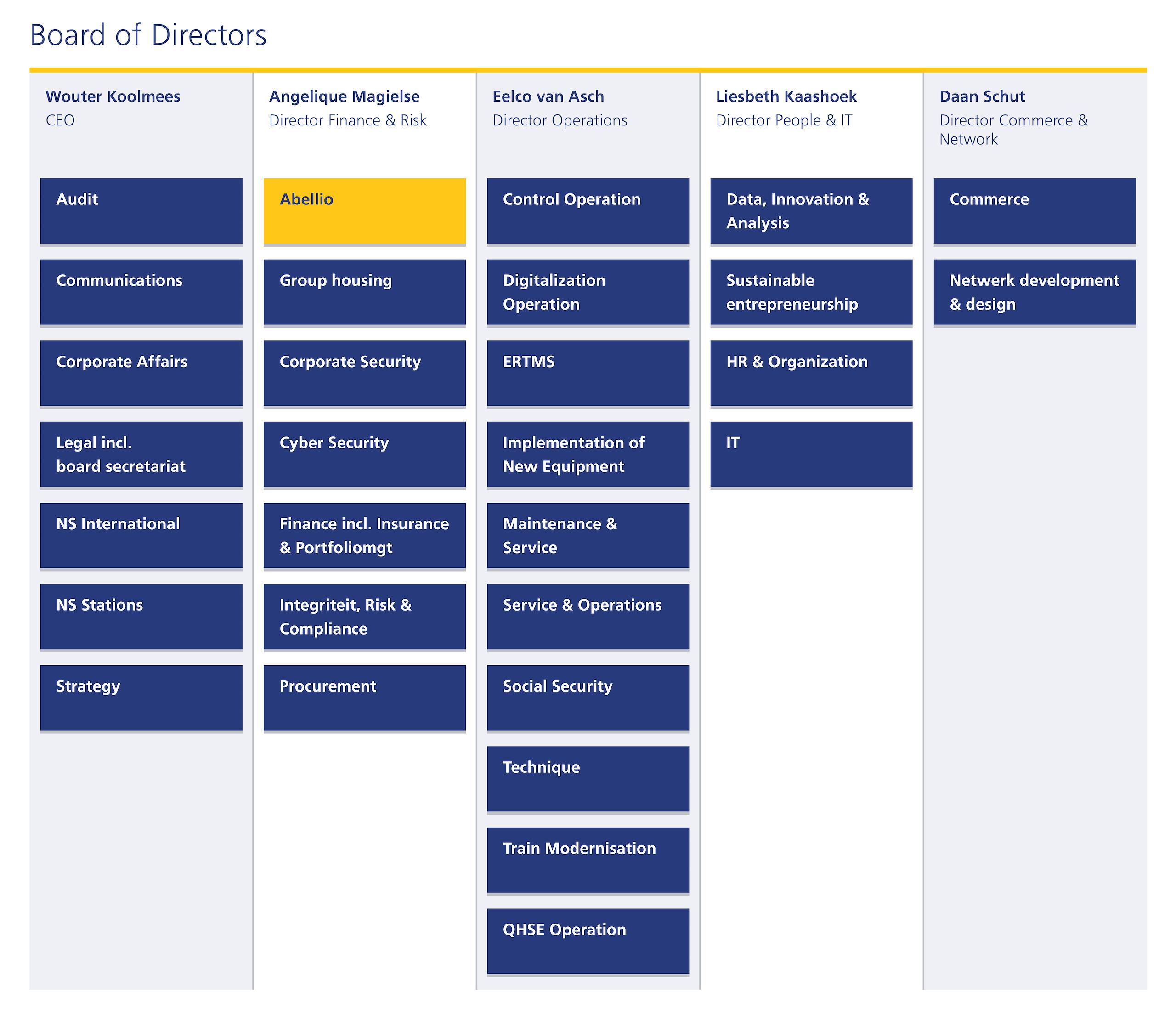
NV Nederlandse Spoorwegen (NS) is a public limited company under Dutch law. Its registered office is in Utrecht. NS is a state-owned company with the Dutch state as its sole shareholder. The role of company shareholder is performed by the Ministry of Finance. NS is the holding company of NS Groep N.V. NS has a two-tier governance structure with an Executive Board and a Supervisory Board. The Executive Boards of NS Groep N.V. and NS consist of the same people (a personal union). The Supervisory Board oversees the Executive Board.
The annual general meeting of shareholders (AGM), in which the State of the Netherlands is represented by the Minister of Finance, is the highest body within the company. The AGM appoints the members of the Executive Board and the Supervisory Board, both on the recommendation of the Supervisory Board. Members of both the Executive Board and the Supervisory Board are appointed in accordance with the profile. For one-third of the number of Supervisory Board members, the Supervisory Board nominates a person recommended by the Central Works Council. Major strategic, financial and organisational decisions require the approval of the Supervisory Board and, in certain cases, the shareholder, as stipulated in the articles of association and management regulations.