Climate and energy
The train is a sustainable choice for medium distances and is part of the solution to climate change. We make the biggest climate impact by encouraging passengers to travel by train instead of by car or plane, reducing CO2 emissions in our value chain and optimising our energy consumption. More extreme weather due to climate change is increasing pressure on stations and infrastructure.
The material theme 'Climate and energy' incorporates the sub-themes 'Climate mitigation' and 'Climate adaptation':
|
Material impacts, risks and opportunities |
Value chain |
Policy |
Action plan |
|
|
Sub-theme: Climate mitigation |
||||
|
The positive impact of CO2 emissions avoided by offering sustainable transport options as an alternative to travel by plane and car |
Positive impact |
Own operations |
|
|
|
The negative impact of CO2 emissions caused in NS's value chain, related to NS's operations (scope 1, 2 and 3 emissions) |
Negative impact |
Entire value chain |
|
|
|
The negative impact of energy consumption in NS's operations on the availability of energy in the Netherlands |
Negative impact |
Own operations |
|
|
|
Sub-theme: Climate adaptation |
||||
|
The risk of critical stations and buildings becoming inaccessible or unavailable due to access restrictions or damage caused by increasing flooding and high temperatures as a result of climate change |
Risk |
Own operations |
- |
|
|
The risk of timetable disruptions due to infrastructure failures and constraints caused by increasing flooding and drought as a result of climate change |
Risk |
Upstream |
- |
|
Climate mitigation
Material impacts, risks and opportunities
Impacts
NS's impact on climate mitigation has both positive and negative aspects. NS makes a positive contribution by offering a more sustainable transport alternative for medium distances, avoiding CO₂ emissions. At the same time, emissions are generated through NS’s own operations and in the value chain that have a negative impact. As a major consumer of energy, particularly for running trains, NS also has an impact on the availability of energy in the Netherlands.
Policy, actions, indicators and targets
Policy
NS's climate policy is based on what we refer to as the NS ‘Trias Energetica’. The core principles are: Saving Energy, Generating Energy and Purchasing Green Energy. This approach, inspired by TU Delft's Trias Energetica (1979), determines direct and indirect emissions. This means that the policy covers emissions from own operations (scope 1), purchased energy (scope 2) and emissions from the value chain (scope 3).
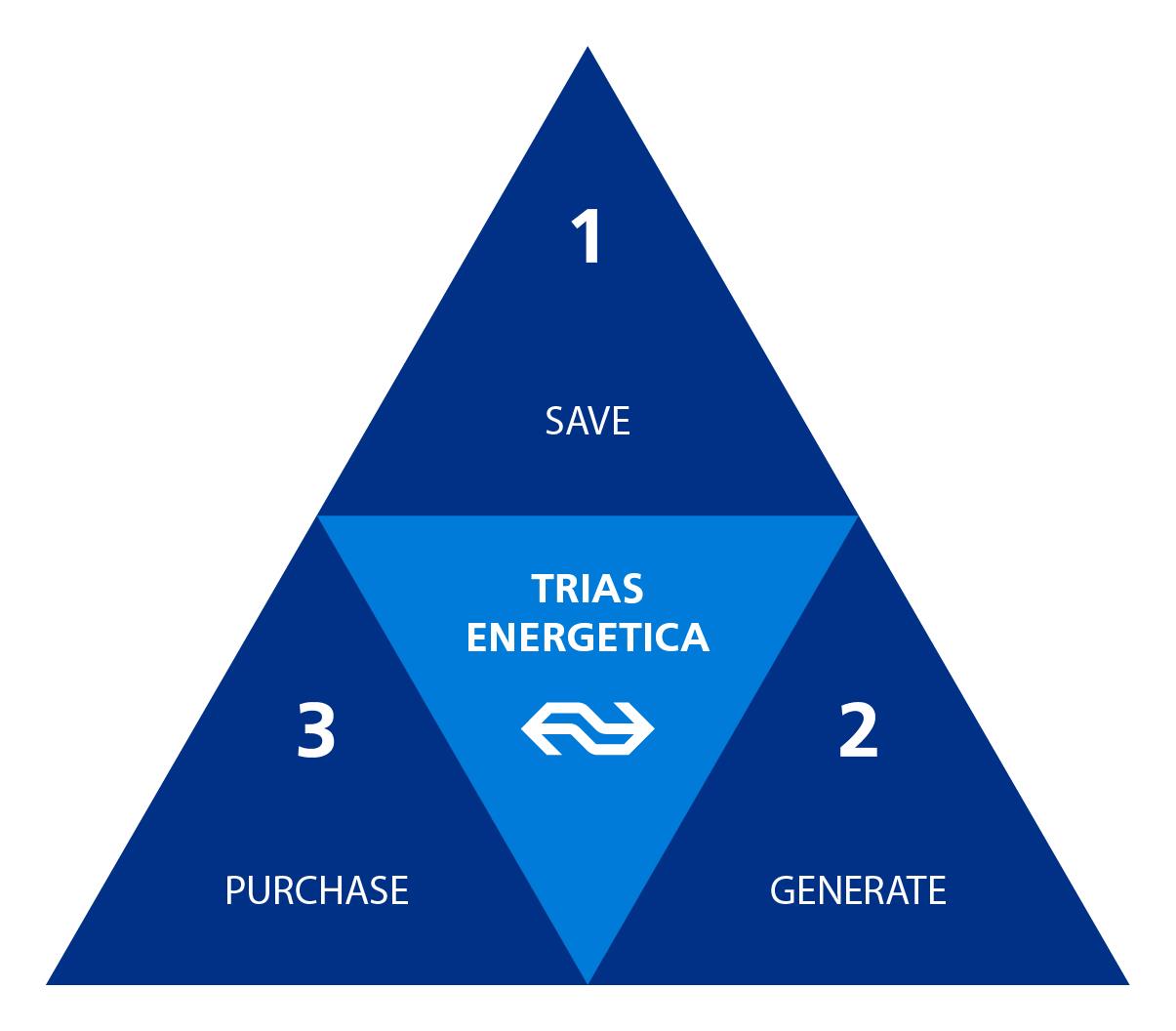
We actively seek to reduce our CO₂ emissions by widely implementing the NS Trias Energetica. We focus on emission reduction within our own operations and the value chain, supporting the roll-out of renewable energy, efficient energy consumption and socially responsible commissioning and procurement (SRCP).
To tackle climate mitigation effectively, our strategy extends beyond CO2 reduction and sustainable energy management. Circularity is also an important pillar (see Circularity and material use).
Saving energy (energy efficiency)
Our efforts to save energy focus on levelling off and reducing NS's energy demand. We specifically measure and reduce consumption of traction electricity, real estate electricity, natural gas and heat (facilities energy). This lowers our carbon emissions.
Generating energy and purchasing green energy
We use our own buildings and land to generate energy from renewable sources, such as sun and wind. To cover our remaining energy demand, we purchase green electricity with guarantees of origin. This means that we are less dependent on external energy sources and less vulnerable to fluctuations in energy prices, as well as reducing emissions.
Socially responsible commissioning and procurement
The supply chain (goods and services) makes a significant contribution to our climate impact. When making procurement and purchasing decisions, we seek to reduce the CO₂ footprint of the required product or service during production, transport, use and at end-of-life. This is set out in our SRCP policy.
Climate mitigation transition plan
NS has drawn up a climate mitigation transition plan including targets, levers and actions to reduce its negative impact on the climate through greenhouse gas emissions. The transition plan describes the steps we will take from 2025 to achieve our targets. The plan is updated annually in conjunction with NS's strategic and financial planning. The plan looks at various 'levers' or ways of generating fewer emissions. Internal stakeholders were consulted in drawing up the levers and reduction targets. The external levers are based on public reports such as the Climate and Energy Report of the PBL Netherlands Environmental Assessment Agency. NS also takes into account possible growth, as an increase in passenger kilometres may lead to higher emissions.
Targets and transition path
NS has science-based reduction targets for greenhouse gas emissions. The reduction targets are location-based and absolute, not per passenger kilometre. The ultimate goal is to achieve net-zero emissions throughout the chain (scope 1, 2 and 3) by 2050. This is in line with the IPCC 1.5°C scenario.
To achieve this, intermediate goals have been formulated. For scope 1 and 2 emissions, over which NS has the most direct control, NS will adhere to the 1.5°C scenario until 2030. After 2030, NS aims to achieve net-zero emissions by 2040. For scope 3 emissions, where influence and control are more limited and there is greater reliance on third parties, NS will adhere to the well-below 2°C scenario until 2030. After 2030, the reduction targets will become stricter to achieve net-zero emissions throughout the chain by 2050.
The approach is in line with the SBTi guidelines and will be continuously reviewed and adjusted to ensure NS meets its targets and contributes to global climate change mitigation efforts.
Our targets and transition path are shown in the table below. Only targets marked * are validated science-based targets; the rest have been determined by linear interpolation or summed for illustrative purposes. We use 2019 as the base year because this was the most recent representative year when the science-based targets were set and submitted in 2023. The years 2020-2022 are not representative for the purpose of comparison due to the COVID pandemic and related NS lockdowns.
|
CO2 emissions** |
Unit |
2025 |
2019 |
Target in 2025 |
Target in 2030 |
Target in 2040 |
Target in 2050 |
|
Scope 1 |
kilotonnes of CO2 equivalent |
12 |
16 |
12 |
8* |
2* |
2* |
|
reduction compared to 2019 |
22% |
- |
25% |
46%* |
90%* |
90%* |
|
|
Scope 2 |
kilotonnes of CO2 equivalent |
271 |
491 |
367 |
264* |
49* |
49* |
|
reduction compared to 2019 |
45% |
- |
25% |
46%* |
90%* |
90%* |
|
|
Scope 3 |
kilotonnes of CO2 equivalent |
439 |
573 |
487 |
415* |
236 |
57* |
|
reduction compared to 2019 |
23% |
- |
15% |
28%* |
59% |
90%* |
|
|
Total |
kilotonnes of CO2 equivalent |
722 |
1079 |
866 |
688 |
287 |
108 |
|
reduction compared to 2019 |
33% |
- |
20% |
36% |
73% |
90% |
- *Validated science-based targets.
- **Table does not always add up arithmetically due to rounding. The reduction is calculated on unrounded numbers.
Our short-term science-based targets for 2030 are a 46% reduction in scope 1 and 2 and a 28% reduction in scope 3 compared to 2019. Our long-term science-based targets are a reduction of at least 90% for scope 1 and 2 by 2040 and for scope 3 by 2050. In other words, a reduction of at least 90% by 2050 compared to 2019, plus offsetting of the remaining emissions.
Decarbonisation levers
We have identified decarbonisation levers that will allow us to reduce emissions on a long-term basis from 2025 onwards. These are categories of emissions to which we link specific reduction actions. We do this both for our own operations and in the value chain. The levers are (from large to small):
Traction energy (scope 2): saving electricity through energy-efficient driving and set-up and smarter use of rolling stock
Procurement (scope 3): socially responsible commissioning and procurement and as many circular raw materials as possible
Facilities energy (scope 1 and 2): less natural gas and electricity through more sustainable buildings and energy-conscious behaviour
IT consumption (scope 3): sustainable data centres and hardware
Transport (scope 1 and 3): electrification of NS and chain partners' vehicle fleet
Other emissions (scope 1 and 3): reduced refrigerant leakage and higher circular outflow
External levers (scope 2 and 3): greening of the national electricity and mobility mix
The diagram below shows the reduction achieved since 2019, the expected increase due to increase in passenger kilometres, and the expected impact per lever in relation to our target in 2030, 2040 and 2050.
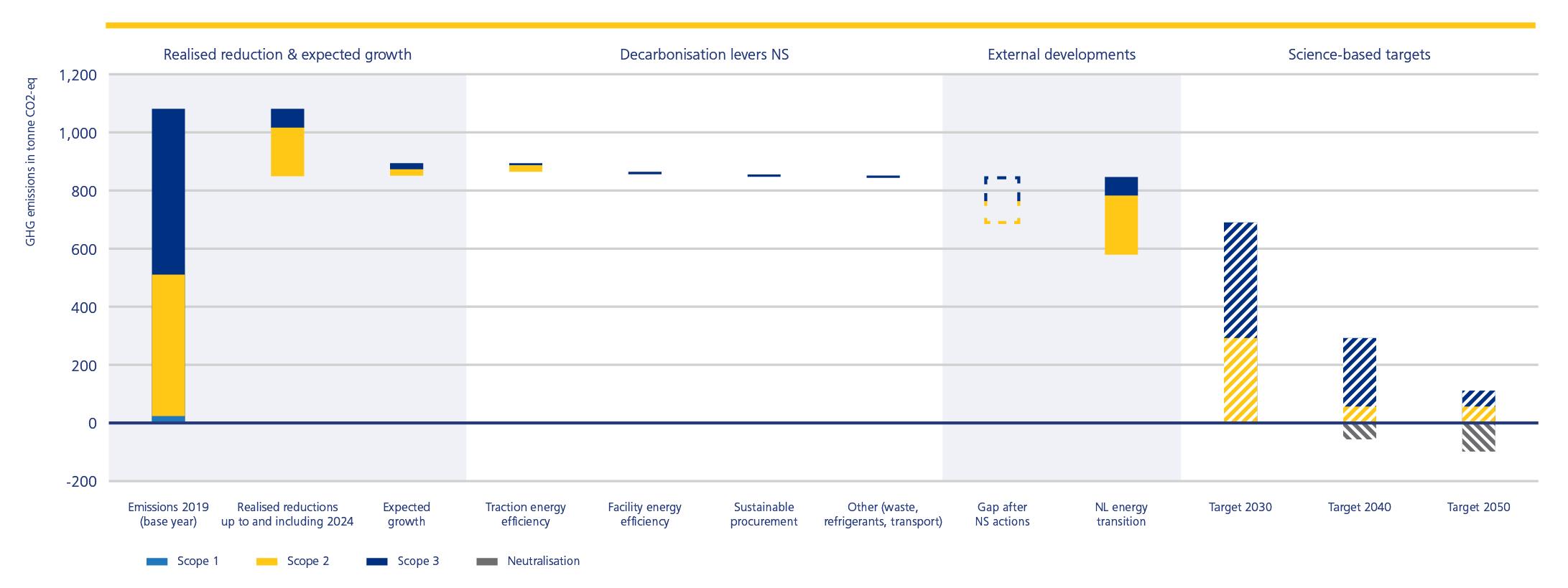
Neutralisation involves the permanent removal and storage of CO2 from the atmosphere. This is only done to offset the climate impact of greenhouse gas emissions that are unavoidable after their target date for net zero emissions.
Action plans by scope and lever
Key actions and progress are described for each emission scope.
Scope 1 – Direct emissions
Facilities energy: reducing gas consumption
To achieve the target of a 46% reduction in scope 1 CO₂ emissions by 2030 compared to 2019, the main lever lies in reducing gas consumption on a long-term basis within our offices, workshops and stations.
At the maintenance facilities, the heating supply is being gradually converted to heat pumps, further reducing natural gas consumption. The commissioning of the new, gas-free, rolling stock concourse in Haarlem significantly contributes to reducing gas consumption. Starting in 2026, a thermal energy storage facility is also to be commissioned in phases in Haarlem to provide sustainable heating and cooling. Finally, NS-wide efforts are being made to permanently reduce energy consumption by using more energy-efficient equipment.
Several measures are being taken to further reduce gas consumption at stations and other real estate. For example, buildings and internal shells are being fitted with additional insulation to reduce heat loss. Central heating boilers are also being replaced with electric or hybrid heat pumps, with these upgrades being coordinated as closely as possible with natural maintenance or replacement schedules. Options to sell or dismantle real estate in locations where further improving sustainability is not feasible are also being explored
Furthermore, the business units encourage employees to adopt energy-conscious behaviour, such as economical use of heating and closing doors.
Transport: electrification of NS's vehicle fleet
Fossil fuel emissions in the vehicle fleet will be further reduced by replacing fuel vehicles with electrically powered vehicles. NS's goal is to have an all-electric fleet by 2030. The policy is currently being reviewed with a focus on target groups that cannot yet be fully electrified, such as Safety & Service's on-call service or vans used by Maintenance & Service.
Other: refrigerants
Ways to further reduce refrigerant emissions are being explored, including through the use of alternative, more environmentally friendly, refrigerants.
Conclusion
With the measures already in place, we are well on track to achieve the 2030 reduction target. Together, the measures add up to over 40% reduction from 2025, so there is still a 6% reduction 'gap' to reach the 46% target. At the same time, we are exploring additional opportunities to meet the full target. Some of these initiatives also contribute towards achieving our long-term goals for 2040 and 2050.
Scope 2 – indirect emissions from the generation of purchased energy
Traction energy: energy-efficient driving and set-up
To achieve the 46% savings target by 2030 (vs 2019) in scope 2, the main internal lever is to reduce energy consumption from operating trains.
Our 'Energy-efficient set-up' (EZO) and 'Energy-efficient driving' (EZR) programmes ensure more efficient use of rolling stock and energy. The EZR programme provides drivers with training and tools to help them drive more energy-efficiently, while the EZO programme focuses on the correct use of EZO mode at yards. Interdepartmental cooperation is being improved and long-term energy savings are being made through monitoring, dashboards and automation.
Facilities energy: reducing electricity
Reducing facilities energy also contributes towards achieving our scope 2 reduction target. Machinery and equipment are gradually being replaced with energy-efficient versions, such as the revamped train wheel repair facility in Leidschendam. The transition from gas to electricity for heating may lead to an increase in electricity consumption. In new buildings, any higher electricity demand is offset by solar panels, limiting growth in consumption. At stations and real estate, NS Stations is implementing measures such as large-scale LED replacement and more efficient equipment, such as cooling systems with energy-saving doors. In addition, employees are encouraged to adopt energy-conscious behaviours. We are also exploring energy storage and generation options, including a battery storage pilot at Amersfoort station, with the aim of rolling out these solutions more widely from 2030 onwards.
External lever: greening of the national electricity mix
The greening of the national electricity mix is the biggest driver to reduce scope 2 emissions. We are dependent on external developments for this. The influence we as NS can exert in this area is limited. What we are indeed doing is to encourage the transition to green power by being an active purchaser of solar and wind power ourselves and engaging in dialogue with our stakeholders.
Conclusion
The internal measures and reductions already achieved add up to a 34% reduction from 2025. Also taking into account the greening of the national electricity mix, we expect to achieve a total reduction of 76%, which is well above the target of 46%.
Scope 3 – Indirect chain emissions
Socially responsible commissioning and procurement
To achieve the 28% reduction target by 2030 (vs 2019) in scope 3, the main internal lever is socially responsible commissioning and procurement.
Procurement of goods, including capital goods, and services is one of the largest sources of emissions for which NS is responsible. To reduce these emissions, NS is working with its suppliers to challenge the market to choose products and services that produce fewer greenhouse gases.
NS has had a SRCP policy in place for several years, where sustainable choices are taken into account when selecting suppliers and products. Depending on the purchasing category, different strategies are followed to reduce emissions. Key strategies include circular design, using sustainably produced materials within products and reducing energy consumption in services.
Our ability to make quantitative predictions of the resulting emission reductions is currently still very limited. The transition plan therefore includes a modest reduction. We are in the process of further deepening and expanding these insights, so that more detailed and greater emission reductions can be achieved in the future.
IT consumption: sustainable data centres and hardware
An important lever to reduce scope 3 emissions is limiting emissions within the IT chain. Ways of achieving this include increasing efficiency, which reduces both costs and emissions, and accelerating migration to the public cloud, which is significantly more efficient than private hosting. In addition, a number of sustainability guilds have been set up within the organisation. These guilds are made up of employees who work out specific plans on various IT topics to achieve further reductions. These initiatives cover a wide range of topics that are being further developed.
Transport: making transport before and after the train journey more sustainable
We are committed to reducing CO2 emissions from transport before and after the train journey by further encouraging sustainable mobility within the chain. We are taking a number of measures to this end, such as adding additional charging stations at P+R sites, renewing and expanding the public transport bicycle fleet, and introducing the 24-hour free parking concept to make bicycle parking more accessible and promote bike-to-train transport. In addition, NS is working with municipalities and ProRail on new staffed bicycle parking facilities using this concept. NS also continues to influence the station environment, ensuring adequate space and facilities for pedestrians, cyclists, Kiss & Ride and connecting public transport. Finally, NS enters into contracts with contracting authorities for charging facilities so that bus operators can increasingly drive electric.
External lever: greening of the mobility mix
The Netherlands' vehicle fleet is increasingly made up of battery electric vehicles. Compared to 2024, the number of these vehicles is expected to quadruple by 2030[1]. This also has an impact on NS's chain emissions, particularly emissions from transport before and after the training journey, but also from NS staff commuting. The resulting level of emission reduction largely depends on how fast the percentage of electric cars in the Netherlands grows.
Conclusion
To achieve the targeted 28% reduction in scope 3 emissions by 2030, NS has identified the following key actions: implementation of SRCP policy (with a particular focus on sustainable procurement and circular raw material flows), limiting IT consumption and electrification of transport before and after the train journey. With the implementation of the specific plans, the expected reduction is 22% from 2025. This takes us a long way towards achieving the 28% target, however additional actions are still needed.
Looking ahead to 2040 and 2050
The roadmap to climate neutrality by 2050 requires continuous innovation and collaboration. NS remains committed to gradually reducing emissions and transparent emissions reporting. In the coming years, NS is expected to focus on ambitious targets in line with European climate goals and society’s expectations. A key focus here is the environment: NS aims to reduce scope 1 and 2 greenhouse gases by at least 90% by 2040, and to achieve net-zero greenhouse gas emissions throughout the chain by 2050. This means operating in a completely fossil-free and circular way wherever possible, further increasing energy efficiency and using renewable energy in all business activities.
CO2 indicators and targets
Carbon emissions
For the CO2 calculations, we work according to the guidelines from the Greenhouse Gas (GHG) Protocol, the global standard for determining greenhouse gas emissions at a company level. When measuring CO2 emissions, we distinguish between Scope 1, 2 and 3 emissions in accordance with the GHG Protocol.
We look at carbon equivalent emissions in all scopes. This means that in addition to CO₂, other relevant greenhouse gases (such as CH4, N2O, HFCs, PFCs, SF6 and NF3), if relevant, are also included and expressed as CO₂ equivalents. Where possible, emission factors from the platform CO2emissiefactoren.nl are used. For the scope 3 categories 'capital goods' and 'purchased goods and services', supplier-specific or product-specific emission factors are increasingly used. Where this is not possible, a spend-based emission calculation is performed using the EXIOBASE database. The scope 3 category 'downstream transportation and distribution' includes CO2 emissions resulting from passenger transport before and after the train journey. These emissions are calculated based on the total number of journeys made by all NS passengers, the distribution by means of transport as determined through survey research, and the travel distance, whereby the straight-line distance from the survey is multiplied by a detour factor. The 'operational control' approach was used to consolidate emissions. Biogenic CO2 emissions are reported separately.
We calculate scope 2 emissions in two ways:
Location-based: this measurement method calculates emissions based on average available electricity in the Netherlands, without distinguishing between green and grey energy contracts.
Market-based: this measurement method takes into account the contractual agreements concluded by NS for the purchase of electricity, including guarantees of origin that prove the electricity was generated from renewable sources.
From this year onwards, we will no longer report according to the matching measurement method, which takes into account the simultaneous alignment of energy generation and energy consumption. This is not an option under our current energy contract.
Total (location-based) emissions were 722 kilotonnes in 2025, 12% lower than in 2024. This is mainly the result of a decrease in traction energy (scope 2) due to the greening of the electricity mix and increased traction efficiency. Compared to the reference year 2019, there was an average annual reduction of 3.7% in scope 1 (target: 4.2%), 7.5% in scope 2 (target: 4.2%) and 3.9% in scope 3 (target: 2.5%). NS is therefore largely reducing its emissions in line with the science-based targets it has set.
|
Greenhouse gas emissions in kilotons of CO₂ equivalents* |
2025 |
2024 |
2019 (base year) |
delta (%) vs. 2024 |
goal 2030 |
|
Scope 1 - direct emissions |
12 |
12 |
16 |
-2% |
8 |
|
1: stationary and mobile combustion |
8 |
9 |
12 |
-6% |
|
|
2: fugitive and process emissions |
4 |
4 |
4 |
6% |
|
|
Scope 2 - indirect emissions from purchased energy |
|||||
|
Location-based |
271 |
328 |
491 |
-17% |
264 |
|
1: electricity |
270 |
328 |
490 |
-18% |
|
|
2: heat |
1 |
0 |
1 |
79% |
|
|
Market-based |
1 |
0 |
1 |
79% |
|
|
Scope 3 - indirect emissions from the value chain** |
439 |
475 |
573 |
-8% |
415 |
|
1: goods and services purchased |
172 |
189 |
202 |
-9% |
|
|
2: capital goods |
45 |
73 |
111 |
-38% |
|
|
3: fuel and energy-related activities |
47 |
21 |
17 |
118% |
|
|
4: upstream transport and distribution |
5 |
8 |
8 |
-31% |
|
|
5: effluents and waste |
4 |
4 |
7 |
-6% |
|
|
6: business travel |
1 |
1 |
1 |
-29% |
|
|
7: regular home/work commute |
9 |
10 |
5 |
-7% |
|
|
9: downstream transport and distribution*** |
140 |
150 |
195 |
-7% |
|
|
13: downstream leased assets |
16 |
19 |
26 |
-17% |
|
|
Total emissions (location-based) |
722 |
816 |
1,079 |
-12% |
|
|
Total emissions (market-based)**** |
440 |
474 |
567 |
-7% |
- *Table does not always add up arithmetically due to rounding. The delta has been calculated using unrounded numbers.
-
**NS reports on all relevant scope 3 categories. The table shows no emissions in a number of scope categories, for the following reasons:
(1) relevant emissions are already reported elsewhere in this table (category 8 - upstream leased assets; category 12 - end-of-life processing of sold products; category 14 - franchises)
(2) the category does not apply (category 10 - processing of products sold), or
(3) emissions are estimated to be immaterial (category 11 - use of products sold; category 15 - investments). - ***The 2024 comparative figure has been adjusted to 150 kilotonnes of CO2 equivalents (2024 annual report: 172 kilotonnes of CO2 equivalents). Based on the latest research, a distinction can be made between trips by bicycle and by moped from 2024 onwards. In addition, the number of transport movements before and after the train journey is estimated more accurately by a new model.
- ****In the total market-based emissions, in addition to scope 2, market-based calculations have also been made for scope 3 category 13 (energy consumption of tenants at NS locations).
Scope 1 emissions
Our scope 1 emissions were 12 kilotonnes of CO2 in 2025 (2024: 12 kilotonnes). Of this, 8 kilotonnes came from fuel consumption by vehicles and building heating systems and the rest from refrigerants - substances used to transport heat in cooling and climate control systems.
Scope 2 emissions
Our total location-based emissions in 2025 were 271 kilotonnes of CO2 (2024: 328 kilotonnes). Of this, 257 kilotonnes came from running trains and 14 kilotonnes from electricity in buildings. The 2025 figures are 17% lower than those for 2024, largely because the share of renewables in the Dutch energy mix has increased. Absolute electricity consumption was 1% higher in 2025 than in 2024 due to an increase in passenger kilometres, but has decreased per passenger kilometre.
In 2025, NS purchased 100% renewable electricity on an annual basis through Guarantees of Origin (GOs). This meant that, according to a market-based calculation, no scope 2 emissions were caused by electricity consumption. Due to the use of district heating at some locations, NS's total market-based scope 2 emissions were 1 kilotonne of CO2.
Scope 3 emissions
Our scope 3 emissions were 439 kilotonnes of CO2 in 2025 (2024: 475 kilotonnes). The largest share comes from purchased goods, services and capital goods (218 kilotonnes). This includes new trains, train components, retail product range, construction projects and operating assets. Passenger transport before and after the train journey (140 kilotonnes) was also a major source of emissions in NS's chain. This concerns the CO2 emissions generated by transport before and after the journey of train passengers travelling to and from NS stations by methods such as bus, electric or fuel car, tram and metro. Chain emissions (‘well-to-tank emissions’) from fuel extraction and production (47 kilotonnes) and energy consumption by external tenants at stations (16 kilotonnes) also contribute to scope 3 emissions. Emissions from replacement bus services amounts to 4 kilotonnes. The remainder consists of business travel and commuting by NS staff, transport and distribution of purchased goods, and waste.
Scope 3 emissions decreased by 8% compared to 2024. This was the result of lower emissions from procurement, due to fewer purchases of new equipment and lower emissions from purchased goods and services, and lower emissions from transport before and after the train journey due to reduced emissions from bus transport in the Netherlands.
Since 2019, NS has offered carbon-neutral replacement bus services provided by buses that use renewable fuels directly and indirectly (through compensation journeys for other customers). Remaining emissions are offset with 'Gold Standard' Verified Emission Reductions (VERs). NS is working with partners on innovations for zero emission solutions. A year-long trial of electric coaches yielded positive results, although operating range, charging costs and charging infrastructure remain challenges. A hydrogen bus trial showed that hydrogen is not a viable alternative in the short term due to technical limitations, high costs and limited availability of green hydrogen.
CO2 emissions per passenger kilometre
The table shows the CO2 emissions per passenger-kilometre based on running trains (traction energy and replacement bus services) and based on NS's total emissions. Operating the trains, including replacement bus services, still results in (market-based) 0 grams of CO₂ per passenger kilometre. For comparison, an average car generates (market-based) emissions of 146 grams of CO2 per passenger kilometre. Total (location-based) emissions from all activities of NS and its supply chains fell once again to 44 grams per passenger kilometre.
|
Emissions per passenger kilometre |
Unit |
2025 |
2024 |
2019 |
|
For train operation: traction energy + replacement transport |
grams of CO2/km |
0 |
0 |
0 |
|
For total emissions: scope 1 + 2 (location-based) + scope 3* |
grams of CO2/km |
44 |
51 |
57 |
|
Passenger kilometres |
billion km |
16.5 |
16.1 |
18.9 |
- *The 2024 comparative figure has been adjusted to 51 grams of CO2/km (2024 annual report: 52 grams of CO2/km) due to the adjustment in scope 3 (category 9: downstream transportation and distribution).
Biogenic CO2 emissions
Biogenic CO₂ emissions come from organic sources such as plants, trees and food waste. Unlike CO₂ emissions from fossil sources, this carbon was removed from the air relatively recently by photosynthesis. As a result, provided conditions are met, CO₂ emissions of this type do not in principle contribute to climate change in the long term.
NS's total biogenic CO2 emissions were 1.1 kilotonnes of CO2 in 2025 (2024: 1.6 kilotonnes). NS's main source of biogenic CO₂ emissions is the combustion of Hydrotreated Vegetable Oil (HVO) as fuel. This is deployed where electrification is not yet fully possible, such as for a limited number of shunting locomotives (scope 1) and for replacement bus services (scope 3).
CO2 emissions avoided
|
Concession performance indicator |
Unit |
Realisation |
Minimum value |
Target value |
|
CO2 emissions avoided |
kilotonnes |
597 |
562 |
648 |
With the concession performance indicator 'CO2 emissions avoided', we calculate how many CO2 equivalents of emissions NS avoids. The indicator does not serve to measure progress on NS's climate targets, but provides insight into progress on wider societal CO2 reductions associated with the implementation of the main rail network concession. The performance indicator shows the total kilotonnes of CO2 emissions avoided by NS passengers travelling by train instead of by car, minus CO2 emissions in NS's operations and in the supply chain. The scope of this performance indicator is the main rail network concession, in other words excluding NS Stations and NS International. NS has an obligation to achieve at least the minimum value for this performance indicator every year, and to aim to achieve the target value by 2029.
When the minimum and target values were set in 2023, the latest available data from 2022 was used. As the agreements made relate to the future period 2025-2029, and NS has no influence on external factors such as CO₂ emission factors, it has been agreed, in coordination with the Ministry of Infrastructure and Water Management, to adopt the latest available CO₂ emission values as the starting point for these years. This ensures that NS neither suffers nor benefits from developments in these external factors, and we are assessed only on those aspects we are actually (largely) able to influence.
CO2 emissions from suppliers of purchased products are not included in the calculation of the performance indicator, as no suitable measurement tool was available to determine this value at the time of the concession discussions. In line with agreements with the Ministry of Infrastructure and Water Management, these emissions will be added by 2029 at the latest, provided the conditions can be met as agreed with the ministry. This concerns inflow related to the main rail network concession, including trains, train components, machinery and office supplies. CO2 emissions from non-infrastructure construction projects, purchased food and infrastructure are outside the scope of the performance indicator.
With the results achieved in the past year, we arrived at a result of 597 kilotonnes of CO2 emissions avoided. We therefore achieved the minimum value for 2025.
Indicators and targets - Energy
Energy consumption
|
Energy consumption and energy mix |
Unit |
2025 |
2024* |
|
|
Total fuel consumption from non-renewable sources |
GJ |
145,207 |
153,546 |
|
|
Total fuel consumption from renewable sources |
GJ |
1,508 |
1,669 |
|
|
Total electricity consumption |
MWh** |
1,229,465 |
1,214,510 |
|
|
Total heat purchased |
GJ |
27,208 |
22,500 |
|
|
Total energy consumption |
GJ |
4,619,699 |
4,570,503 |
|
|
Share of renewable energy |
% |
96.5 |
96.3 |
- *The comparative figures for 2024 have been adjusted due to improved data availability and quality. The total energy consumption for 2024 has been adjusted to 4,570,503 GJ (2024 annual report: 4,546,327 GJ).
- **To calculate total energy consumption, total electricity consumption (in MWh) was converted to GJ. Conversions to megawatt hours (MWh) and GJ are carried out based on (a) the Netherland Enterprise Agency’s Dutch list of energy carriers and standard CO₂ emission factors, January 2024 version, and (b) Statistics Netherlands energy mass units. In the conversion to renewable fuels, petrol and diesel are assumed to contain 8.5% and 10% biofuel in E10 and B7 respectively.
Total energy consumption by NS in 2025 was 4,619,699 gigajoules (GJ). The change compared to 2024 was an increase of 1.1%. Total electricity consumption increased by 1.2%. One reason for this was the growth in passenger kilometres. The installation of TES facilities increases electricity and heat consumption, however this effect is offset by less consumption of non-renewable fuels (lower gas consumption).
Saving energy
A number of measures have been taken in maintenance facilities to reduce energy consumption by 2025, including LED lighting, heat pumps and insulation. A TES facility has been constructed at our Haarlem train modernisation site and will be brought into use from 2026. In addition, a contract has been signed for the installation of a 1 MWh battery in 2026.
We are also working on energy-efficient, virtually carbon-free stations and buildings and have committed ourselves to the Paris Proof 2050 initiative of the Dutch Green Building Council (DGBC). Through the Portfolio Approach, we agreed to reduce gas by 22% and total energy by 14% by 2026 compared to 2022. The sustainability strategy was adopted in 2024. Implementation of building-related measures started in 2025.
In 2025, NS completed the first phase of the Europe's Rail study into energy storage, together with organisations such as ProRail and international partners. The lab study on energy storage along the track identifies opportunities to make the power in the overhead line more flexible. The next phase will involve building a prototype to better understand the effect on the traction energy supply. The research into energy storage on trains focused on specifying a suitable storage system. Simulations are expected in mid-2026.
Energy efficiency
‘Energy efficiency of traction’ (EET) is the energy consumption of trains per passenger-kilometre. The table shows the EET, passenger kilometres and total energy consumption (traction electricity) of our trains. The total energy consumption includes replacement bus services (diesel). The weather has a major impact on our energy consumption for heating and cooling trains. To compare the energy consumption from operating trains as accurately as possible, energy consumption is normalised to the average temperature of the past 5 years. EET is calculated only for the main rail network.
|
TEE |
Unit |
2025 |
2024 |
|
Traction energy efficiency |
Wh/km |
68.4 |
69.6 |
|
Traction energy |
GWh |
1,085.7 |
1,082.1 |
|
Passenger kilometres |
billion km |
16.1 |
15.9 |
Normalised for temperature, NS consumed 1,085.7 GWh for the purpose of operating trains in 2025. This is an increase of 0.3% compared to 2024. The increase is mainly due to the changes made in the 2025 timetable, in the form of more trains, train kilometres and tonne-kilometres.
Efforts to coordinate rolling stock length with passenger demand, the gradual introduction of the more energy-efficient ICNG and the 1.2% growth in the number of passenger-kilometres compared to 2024 meant that we used less energy per passenger-kilometre in 2025.
Purchasing green energy
NS purchases electricity for trains and buildings through separate contracts. EPNL will supply electricity for trains for a three-year period that started on 1 January 2025. This electricity is being made more sustainable through Guarantees of Origin from wind and solar farms in Europe, purchased through Shell. Eneco supplies electricity for our buildings, and the corresponding GoOs from wind and solar farms in Europe. We anticipate further technological advances in energy generation and storage, and preparing to become less dependent on fossil back-up. The ultimate goal is for the time of use and time of generation to always be the same.
Generating energy
|
Energy production |
Unit |
2025 |
2024 |
|
|
Non-renewable energy production |
MWh |
0 |
0 |
|
|
Renewable energy production |
MWh |
18,553 |
18,343 |
Most of the renewable energy generated by NS itself comes from TES facilities (2025: 17,005 MWh, in line with 2024). We also generated 1,548 MWh of renewable electricity (2024: 1,002 MWh). Renewable electricity generation has increased, with over 3,000 new solar panels installed on our workshop in Berkel-Enschot in 2025.
Collaborations
NS is a member of the Netherlands Association for Sustainable Energy (NVDE).
Collaboration with partners is essential to enable progress. Together the NVDE, we and the other members highlight the switch from car to public transport and shared transport as an indispensable contribution towards achieving climate targets. We also harness the knowledge of the NVDE and its members to develop a long-term energy strategy.
Climate adaptation
Material impacts, risks and opportunities
Risks
In terms of climate adaptation, NS may potentially face risks due to changing weather conditions. Within its own operations, critical stations and buildings could become temporarily unavailable due to access restrictions or damage caused by increasing flooding and high temperatures. In the upstream value chain, failures and restrictions in infrastructure due to increasing flooding and drought may lead to disruptions in NS's timetable.
NS, together with Movares and Arcadis, carried out a physical assessment of key station and maintenance sites, focusing on the impact of physical climate risks on operations. Worse-case scenarios developed by the Royal Netherlands Meteorological Institute were used, based on climate changes up to 2150, such as heat waves, floods, precipitation and drought-related subsidence. The analysis shows that flooding and high temperatures in particular pose long-term risks, with Haarlem, Maastricht and Watergraafsmeer being the most vulnerable maintenance locations. Stations are especially susceptible to heat stress and electrical equipment failure, and almost half of the stations may experience extreme flooding. Rail infrastructure may also be unavailable or damaged due to flooding and the effects of drought on the railway subgrade.
Policy, actions, indicators and targets
Policy
NS adopts a risk-driven approach to climate adaptation, embedded in our continuity measures, to manage the impact of climate change on our critical processes. We systematically identify the risks that climate change poses to our operations and take targeted measures to mitigate these risks. This ensures the continuity of our services, even in extreme weather conditions.
Actions, indicators and targets
The starting point of our climate adaptation approach is to protect NS's business continuity from the anticipated and unanticipated effects of climate change. NS takes seasonal influences into account in its operations and has a continuity plan that sets out contingency measures such as alternative locations and scaling down the timetable in extreme weather conditions. There is a clear process for role allocation in the event that sites are inaccessible, with flexible deployment of rolling stock and staff. In crisis situations, a crisis team meets to determine priorities, supported by special extreme weather procedures to keep infrastructure and trains operational.
NS has no indicators and targets for climate adaptation.
- 1E-LAAD Nationwide growth scenarios