International
International trains contribute to sustainable, economic and social progress. They connect people in the Netherlands with others across the border and bring cultures closer together. By offering modern trains and attractive destinations, we encourage international passengers to choose the train over travelling by plane or car. We mainly focus on destinations within a range of up to 700 kilometres. Up to that distance, a large number of European cities can easily be reached in a sustainable way by train.
Working together to provide a better service
NS International operates international trains in collaboration with foreign train companies: Eurostar, NMBS, DB, ÖBB and SBB. This enables us to provide a better service, such as improved ticket sales with the CER Ticketing Roadmap (Community of European Railway and Infrastructure Companies). One step that has now been completed is that you can book your trip much earlier. Sometimes a year in advance. We are also committed to the Open Sales and Distribution Model (OSDM): an IT standard that will make it easier to book international train tickets at the best possible price.
Our ambition is to double the number of international train journeys by 2030 compared to 2018. In order to achieve this we are making international travel easier, for example by providing good connections to the HSL networks in neighbouring countries, by offering faster and more frequent services, and by adding new destinations.
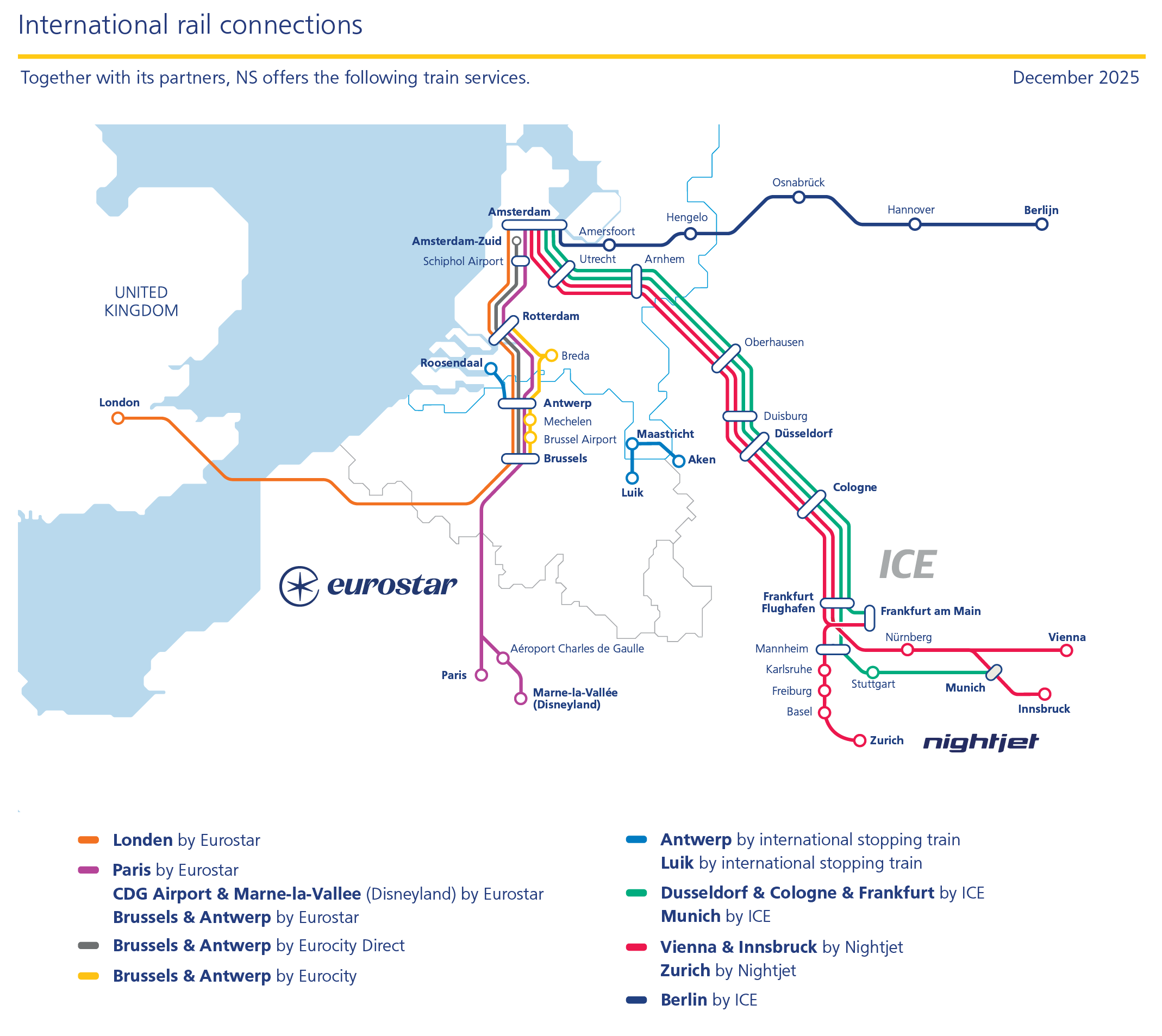
Services such as the Eurocity Direct trains and the EuroCity trains to Antwerp and Brussels are covered by our main rail network concession, as are the regional cross-border trains between Roosendaal and Antwerp and Maastricht and Liège. We operate the other international train services on an open access basis.
Connections within the main rail network concession
Double the number of trains to Brussels
Since the end of 2024, NS International has been working with NMBS to operate the Eurocity Direct from Amsterdam South via Schiphol and Rotterdam to Antwerp and Brussels. We also offer a EuroCity via Rotterdam, Breda, Antwerp and Mechelen to Brussels. The introduction of these two train services doubled the number of trains between Amsterdam and Brussels from 16 to 32 trains in both directions.
More than three million passengers used this connection in the first year, compared to more than two million in 2024 when the only service operating was the IC Brussels 16 times a day. This is a substantial increase that we are positive about, particularly given the start-up problems at launch. Passengers faced cancellations due to logistical challenges, teething problems with the new trains and particularly staff shortages due to the tight labour market. Strikes in Belgium and the Netherlands also resulted in additional delays and cancellations. Since June, Eurocity Direct has been operating entirely with the Belgium-friendly Intercity New Generation (ICNG-B).
To Liège and Antwerp
We operated two regional cross-border connections in conjunction with NMBS in 2025: Antwerp – Roosendaal and Maastricht – Liège. The latter is part of the Three-Country train service, which continues via Heerlen to Aachen (operated by Arriva). Because the train passes through three countries, the service is more vulnerable to disruptions. In the event of problems in Germany or Limburg, we deploy NMBS rolling stock on the Maastricht-Liège connection.
Open access connections
'Open access' is playing an ever-larger role in Europe. Open access means that a carrier operates at its own expense and risk, without concession arrangements with a government. This means that NS International is able to offer services on international routes in competition with other European carriers. We operate Eurostar trains to London, Belgium and France, ICE trains to Germany and Nightjet trains to Austria and Switzerland in open access.
To Belgium and France
NS and Eurostar jointly operate high-speed trains to Belgium and France, with key destinations Brussels South/Midi and Paris Gare du Nord. Throughout the year, there is an hourly service between these cities almost every day. We also operate a weekend service to Marne-la-Vallée (Disneyland® Paris) via Charles de Gaulle airport.
Passenger demand for travel to Paris remains high. Eurostar e320-type trains were therefore deployed to Paris at peak times in 2025. This train type, which has 900 seats, previously operated exclusively on the London route. The conversion of Eurostar PBKA-type train has been completed, increasing the number of seats by 8% and introducing an updated, modern interior.
During the winter sports season, a train (Eurostar Snow) runs every Saturday between the Netherlands and the French Alps to provide a fast and comfortable travel option for winter sports enthusiasts. In the 2024/2025 winter sports season, this train service operated between 21 December 2024 and 12 April 2025. For the 2025/2026 winter sports season, the service will from 20 December 2025 to 4 April 2026.
In the Netherlands, these international trains operate on the HSL-South. The temporary speed limits imposed as a result of construction defects were still in place in 2025, with a maximum speed of 120 km per hour instead of 300 km per hour on some sections. This means longer journey times for Eurostar and Eurocity Direct passengers. The end of speed limits is not yet in sight.
To London
In February 2025, the State Secretary for Public Transport and the Environment opened the new UK Terminal at Amsterdam Central Station. The City of Amsterdam, ProRail, Eurostar, the Ministry of Infrastructure and Water Management, NS Stations and NS International worked together to complete the new terminal on schedule and on budget. They succeeded in doing so. The new UK Terminal will enable trains to return to London again after an eight-month hiatus. The new terminal has more capacity than the old one on platform 15b. Together with the facilities at Rotterdam Central, over 700 passengers can now travel to and from London by train. Three trains per working day were running in February 2025, increasing to four in September and then five from 1 January 2026. In short, around 3,500 passengers a day can travel to and from London by train. Equivalent to around 22 return flights.
To Germany
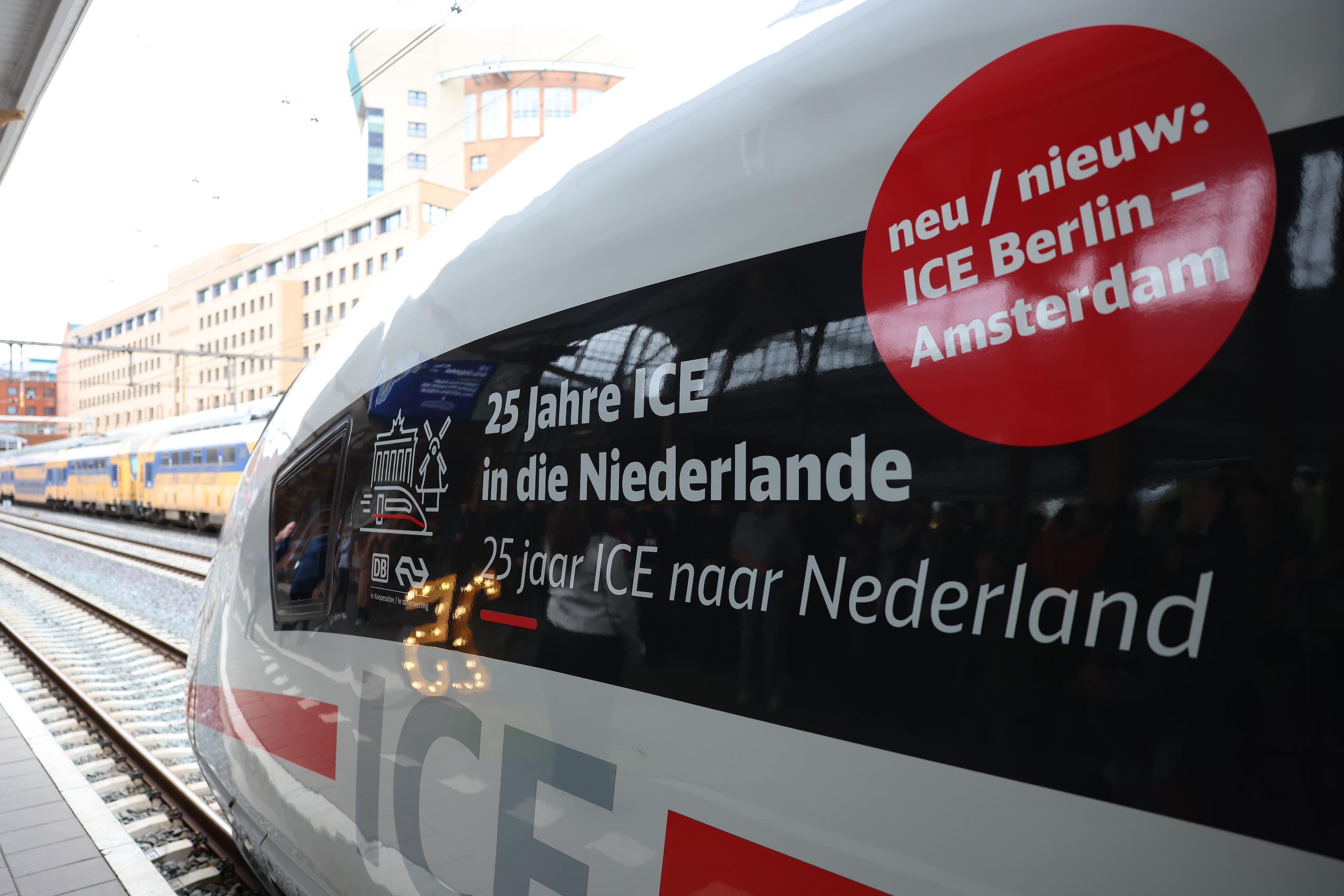
NS operates a train to Berlin every two hours and a train to Cologne and Frankfurt every two hours in collaboration with Deutsche Bahn (DB). As of the 2025 timetable, one train from Frankfurt continues on to Munich.
Since mid-2024, new DB ICE trains have been operating on the route to Frankfurt and Munich. This significantly increased reliability, for example by reducing the number of breakdowns due to technical faults in air conditioning systems or non-working toilets. Less than 1% of trains have been cancelled due to such problems since the new rolling stock was introduced. Yet disruptions in Germany continue to affect punctuality. In 2025, there was a 105-day period in which passengers travelling to and from Frankfurt had to detour via Venlo instead of Arnhem. This resulted in a longer journey time and meant that destinations like Düsseldorf had to be skipped. The numerous works on the German railway led to delays and cancellations.
In 2025, DB's new ICE trains also started operating on the route to Berlin. This was accompanied by the withdrawal of the last classic carriages from the track. The new rolling stock provides a more reliable service and greater comfort for passengers and staff. The connection is now officially an ICE connection with an ICE surcharge within the Netherlands. This surcharge applies only to passengers who do not have an NS season ticket. Passengers are already familiar with the surcharge from the Amsterdam – Utrecht – Arnhem route.
Night trains to Austria and Switzerland
In 2025, night trains ran daily between the Netherlands and the Austrian cities of Vienna and Innsbruck and between the Netherlands and Zurich in Switzerland. NS operates these services in collaboration with ÖBB, SBB and Deutsche Bahn. The night trains operated on an adapted route due to works in Germany. Disruption in Germany continues to affect punctuality.
New ÖBB Nightjet trains have been running between the Netherlands and Vienna/Innsbruck since May 2025. This modern rolling stock meets the needs of today's train passengers with features such as sleeping compartments boasting a private toilet and shower, new sleeping coaches with four-bed rooms and mini cabins for passengers travelling alone. There is space for bicycles and the rolling stock is accessible for people with reduced mobility, including completely barrier-free sleeping compartments.