Stations in the Netherlands
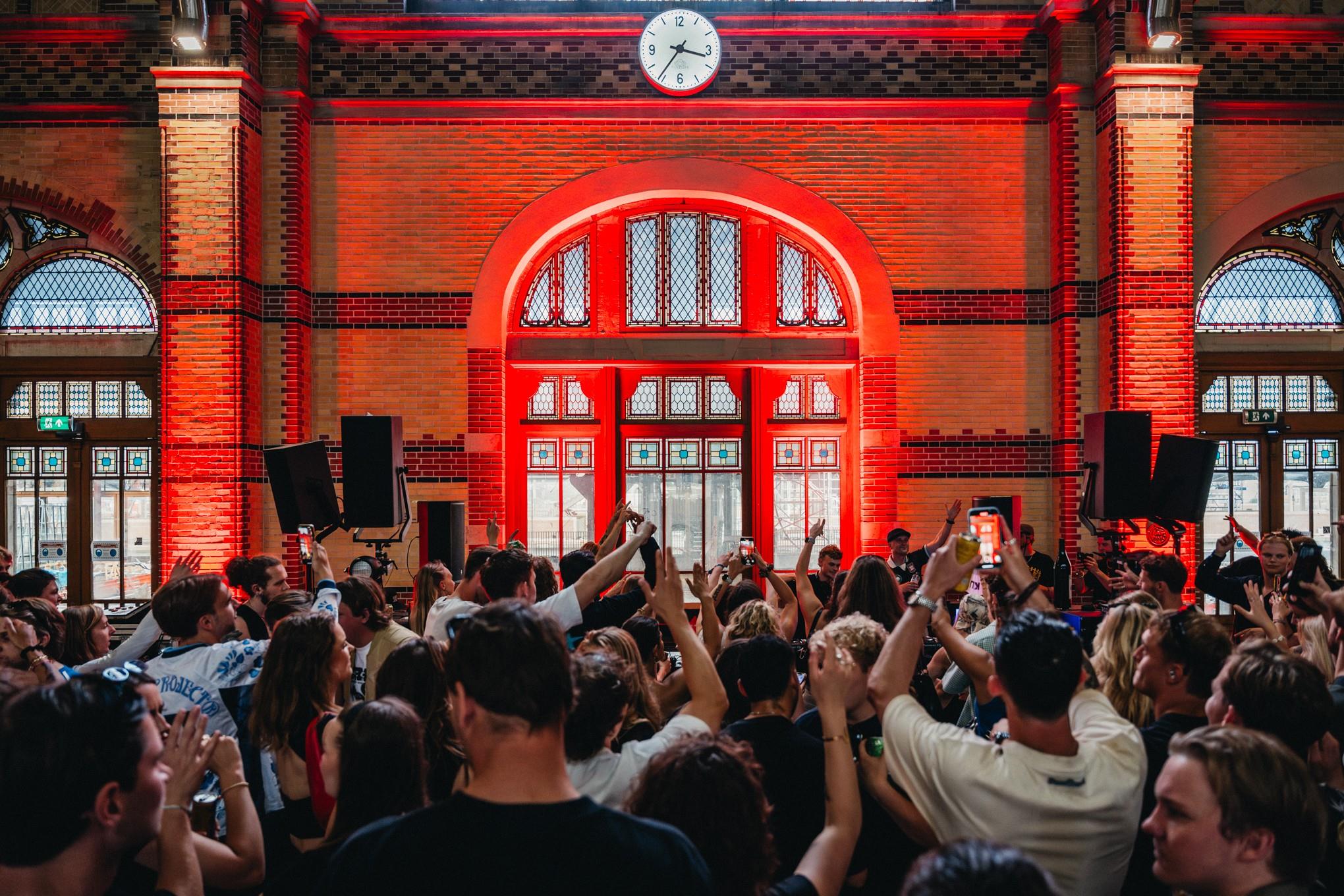
Stations are a central location at the heart of the community. Every day, thousands of people pass each other at stations on their way to their trains or destinations. High-quality stations in pleasant surroundings therefore play an important role in the sustainable accessibility of our country. We want stations to be vibrant and meaningful places where it is pleasant to spend time, travel from and to, and meet. Building in easily accessible locations, with public transport links, shared transport within easy reach and space for bicycles, makes it easier for passengers to make a sustainable choice.
Station Experience Monitor
As much as 25% of the rating our passengers give their journey is determined by what they think of the station. It is therefore important to ensure that passengers experience the station as a pleasant environment. We work with ProRail to carry out the quarterly Station Experience Monitor: a comprehensive survey of station visitors on their station experience. The results tell what is going well and what could be better. In 2025, passengers rated the 393 stations measured an average of 7.2 out of 10.
Shops and amenities at the station
We are constantly working on creating new facilities and a range of retail services that meets the changing needs of passengers, visitors and local residents.
NS Stations leases retail space to operators of shops or catering outlets at stations. Tenants at the station saw their retail sales continue to grow in 2025. In September, it was announced that Bakker Bart will open 14 shops at railway stations in 2026. This will involve converting the BackWerk shops into Bakker Bart To Go outlets. We are always working on making stations more pleasant and improving the station experience. One way we do this is by increasing the number of pop-up stores, with events and activations. We also respond to the needs of our environment, with gyms, pharmacists and health centres. We use our cooperation with social partners to establish connections with the village or town.
In-house retail formats
NS's retail business (NS Stations Retailbedrijf and Stationsfoodstore) operates a number of retail formats: AH to go, Kiosk, Station House and Julia's. There are more than 185 shops in total. Two new AH to go shops opened in 2025 and two Kiosk shops opened at Groningen station in November. We also operate 'Grab & Go' vending machines at stations.
We encourage healthier and more sustainable choices to contribute to a healthier generation and a viable future for the world. We are updating the range with more Wheel of Five products, making other products healthier and improving the balance between vegetable and animal proteins.
Station Living Rooms
The 30 Station Living Rooms are mainly located at smaller stations, where there are few or no other providers. They offer a pleasant space for passengers to wait, work and meet. With the Station Living Room, we commit ourselves to social initiatives that seek to bring people together and to ensure an inclusive society. One of the organisations we worked with in 2025 was Koeckebackers, which gives asylum permit holders and people with poor employment prospects an opportunity to work. By selling Koeckebackers' cakes in the Station Living Rooms, NS and Koeckebackers aim to contribute to making the world a nicer place.
Social and temporary initiatives
We also give space to dozens of social and temporary initiatives at the station every year. Take Haarlem station, for example. There, the landmark building on the central platform has been given a new lease of life. July saw the opening of the new Station Living Room and a miniature railway. This was followed in October by the opening of Museum Mutek, dedicated to applied art.
The temporary Free Fashion pop-up store opened at Utrecht Central in early 2025. With this shop, we supported the initiators of Free Fashion in raising passengers’ awareness of massive overproduction and pollution in the garment industry. A temporary Free Fashion pop-up store at Rotterdam Central followed in July.
Door-to-door services
At the station, we develop and offer various door-to-door services to make train travel easy and attractive. That is why we work with partners to provide bicycle parking facilities, public transport bicycles, Fiets & Service bicycle service facilities, car parking facilities, toilets and luggage lockers.
Bicycle parking and repairs
For many passengers, the bicycle-train combination is part of their journey: almost half of train passengers travel to the station by bicycle.
There are over 325,000 unsupervised parking spaces at stations. Several stations also offer the option to have your bicycle repaired at Fiets & Service, the bicycle repair shop at the station.
Check-in and check-out zone
NS bicycle parking facilities are equipped with special check-in and check-out zones with detection points. You can check in or check out here using a public transport smart card or, for even faster throughput, using a bicycle tag linked to the public transport smart card and attached to the bicycle frame. In 2025, we rolled out more of these new check-in and check-out zones in staffed bicycle parking facilities. This new service is now available at locations including Assen, Sijpesteijn, De Knoop Utrecht Central and Apeldoorn.
Public transport bicycle
In 2025, passengers made 5.9 million rides by public transport bicycle. NS expanded its fleet in 2025 with 5,000 new public transport bicycles, resulting in a total fleet of around 24,000 public transport bicycles by the end of 2025.
We repair public transport bicycles in-house. If a bicycle is beyond repair, circular bike builder Roetz will ensure that the bicycle is disassembled and fully reassembled.
In recent years, we have developed new smart locks for public transport bicycles that are opened using personal public transport smart cards; the rental starts instantly, without the intervention of an NS employee. The further roll-out of the public transport bicycle smart lock in 2025 means that more than 95% of the total fleet will have the new electric lock.
Last autumn, public transport bicycles were affected by three high-profile nationwide IT failures. The failures varied in duration from a few hours to almost 24 hours. Very annoying for our customers, who were unable to hire a public transport bicycle during these periods. Customers were able to return hire bicycles, however when they did so the hire period continued. The hire period stopped automatically once the system was back up and running. Some passengers were unfairly fined for this. The failures were not related. We have developed measures and are carrying out additional monitoring to try to prevent a recurrence of such high-impact failures.
In 2025, we built unstaffed public transport bicycle outlets at 40 stations. This brings the total to 143.
Public transport ebikes
The electric public transport bicycle (public transport ebike) was trialled at Driebergen-Zeist, Arnhem, Maastricht and Groningen in 2024. The public transport ebike proved to be a success with passengers and the pilot project was completed. However, there are no plans to introduce new public transport e-bike locations at present. The ebike market is developing very fast, and expanding the public transport ebike offering will take huge investment. In the coming period, we will focus on running the existing, sustainable operation to build up a reliable offering for passengers. The current public transport e-bikes will remain available at the four pilot stations. A total of 30 public transport e-bikes is available at each of these stations.
Car parking
At most regulated P+R facilities, you can park free of charge. At around 50, you need to pay. Train passengers receive a discounted rate. Particularly in the regions outside the Randstad conurbation, where many people travel to the station by car, P+R facilities are of considerable value in facilitating the car-train combination. We are continuing to invest in shared car facilities: shared cars are now available at two hundred stations.
The station environment of the future
We are working with ProRail and a number of other parties on a strong network of 400 stations, and on developing the areas around the stations. Several stations will be undergoing renovations and station areas undergoing development in the coming years. We are placing a particular focus on sustainability, for example by reducing energy consumption at stations and working towards zero-waste stations.
Sustainability of real estate
NS must meet the commitments made in the Paris Climate Agreement by 2050. In order to do this, NS Stations has been gradually improving the sustainability of its stations and other real estate since 2022. One of the things we have done is to assess our entire property portfolio to identify energy-saving measures. We have adopted a strategy for improving the sustainability of our real estate. We have linked the measures from the assessment to our regular maintenance plans, and the implementation of these measures has been incorporated into the existing maintenance processes for our buildings from 2025 onwards.
A specific project from 2025 is the tendering and award procedure for the large-scale renovation of Stichthage office at The Hague Central Station. Renovation of this office will start in early 2026. These steps will help us to achieve our mission of becoming 'Paris Proof', which we took on in the context of the Dutch Green Building Council in 2023. For more information about sustainable real estate, see our sustainability report.
Art
The stations and their surroundings have a rich tradition of visual art. Art makes passengers' and visitors' stay more pleasant and distinguishes stations. It is important to ProRail and NS to develop and maintain the art collection. Together with ProRail and Bureau Spoorbouwmeester, we provide an art collection that is in keeping with the theme of travel and the public nature of stations. Also check out: www.spoorbeeld.nl (new window)
Stations undergoing renovations
In 2025, we worked with partners to renovate and complete several stations. At Amsterdam Central, the first part of the new UK terminal was transferred to Eurostar in 2025. Direct trains to London have been running again since 10 February. By mid-year, the second part of the terminal was also opened, allowing more passengers to depart. Work has continued on the listed facades of Amsterdam Central and the scaffolding was gradually removed from the De Oost building at the end of 2025. Utrecht Overvecht station was made more sustainable and completed in early 2025, making it future-ready. July saw the opening of the new passenger passage at Groningen station and the start of preparations for the renovation of the existing station building. The renovated Heiloo station was also brought into use in 2025.
Renovation work is also in progress at a number of stations, including Nijkerk, Middelburg, Beverwijk, Muiderpoort and Venlo. In addition, we are preparing to renovate the platform roofs and station at Alkmaar, the square in front of Zwolle station, and the main concourse, bicycle parking facility and the square in front of Nijmegen station hall.
Area development
We are working with other organisations to develop station areas to encourage the use of public transport. This relieves pressure on other infrastructure, as well as making a major contribution to the housing challenge and sustainable accessibility of the Netherlands. We are doing this in collaboration with municipalities, ProRail and others, for example by combining urban functions such as living, working, recreation and education in station area development. Some examples:
Utrecht's Cartesius Triangle is seeing the construction of a new urban district with 2,850 homes. We are working on this project with the Municipality of Utrecht and a consortium of Ballast Nedam and MRP. The possibility of more housing was explored in 2025, resulting in a proposal for up to 800 additional homes.
More than 1,200 homes are to be built in Utrecht's new urban district Wisselspoor on Tweede Daalsedijk. Last year saw the signing of a purchase agreement with VORM for the development of the final subarea featuring 512 sustainable homes. A total of 538 homes were completed in 2025. VORM is expected to start construction of the remaining homes in 2027.
The Wagenwerkplaats in Amersfoort is a long and narrow piece of land between the railway and the Soesterkwartier district. This former NS goods wagon workshop will soon be transformed into an urban district that will house thousands of Amersfoort residents. The Wagenwerkplaats consists of three subareas linked by green parks. In 2025, NS launched a tender procedure for the sale of the western and central subarea for the development of around 500 homes, a mobility hub, community centre and public spaces.
Together with area developer AM and the municipality, we are developing Zwolle Spoorzone into a new station area with between 1,000 and 1,500 homes. Plus around 8,000 m² of offices, educational facilities, cultural spaces and catering services. In 2025, part of the iconic Wärtsilä halls in the heart of Zwolle's Stationskwartier took on a temporary new role as a sports venue boasting 12 padel courts.
Construction at the EKP North site in Den Bosch’s railway zone started in November 2025 with the realisation of the first homes. A living, working and learning area will be created here, including the Art Academy and more than 800 homes.
NS is also involved in a number of other developments, such as 'De Nieuwe kern' (between Duivendrecht station, the Johan Cruijff Arena, A2 and the Amstel Businesspark), the Zuidasdok project in Amsterdam South, Spoorzone Beverwijk and Fuutlaan in Eindhoven.
Building over the tracks
Building over and alongside the tracks near stations helps cities grow while remaining accessible in a sustainable manner. We worked with the municipality of The Hague and ProRail in 2024 to draw up a development strategy for The Hague, which includes scope for building over the tracks at The Hague Central Station. Last year, we followed up on an agreement with the Ministry of Infrastructure and Water Management by working with partners to continue the feasibility study on large-scale urbanisation above the railway in Amsterdam Sloterdijk. This includes improvements to the station itself.
Working together to improve accessibility and high-quality amenities
In many locations, we face a complex task. Passenger numbers are expected to grow in the longer term, while substantial urban development is to take place in the station area. Together with ProRail, the Ministry of Infrastructure and the Water Management, provinces and municipalities, we are carrying out exploratory studies as part of the Multiannual Programme for Infrastructure, Space and Transport (MIRT) to identify what is needed here. For example, we are working on exploratory studies for the stations between Leiden Central and Dordrecht and for the stations and station environments of Nijmegen and Den Bosch.